

In Pervomaisk, children study in classrooms at +6°C, lessons have been reduced to 30 minutes
- Alina KvitkoReporter

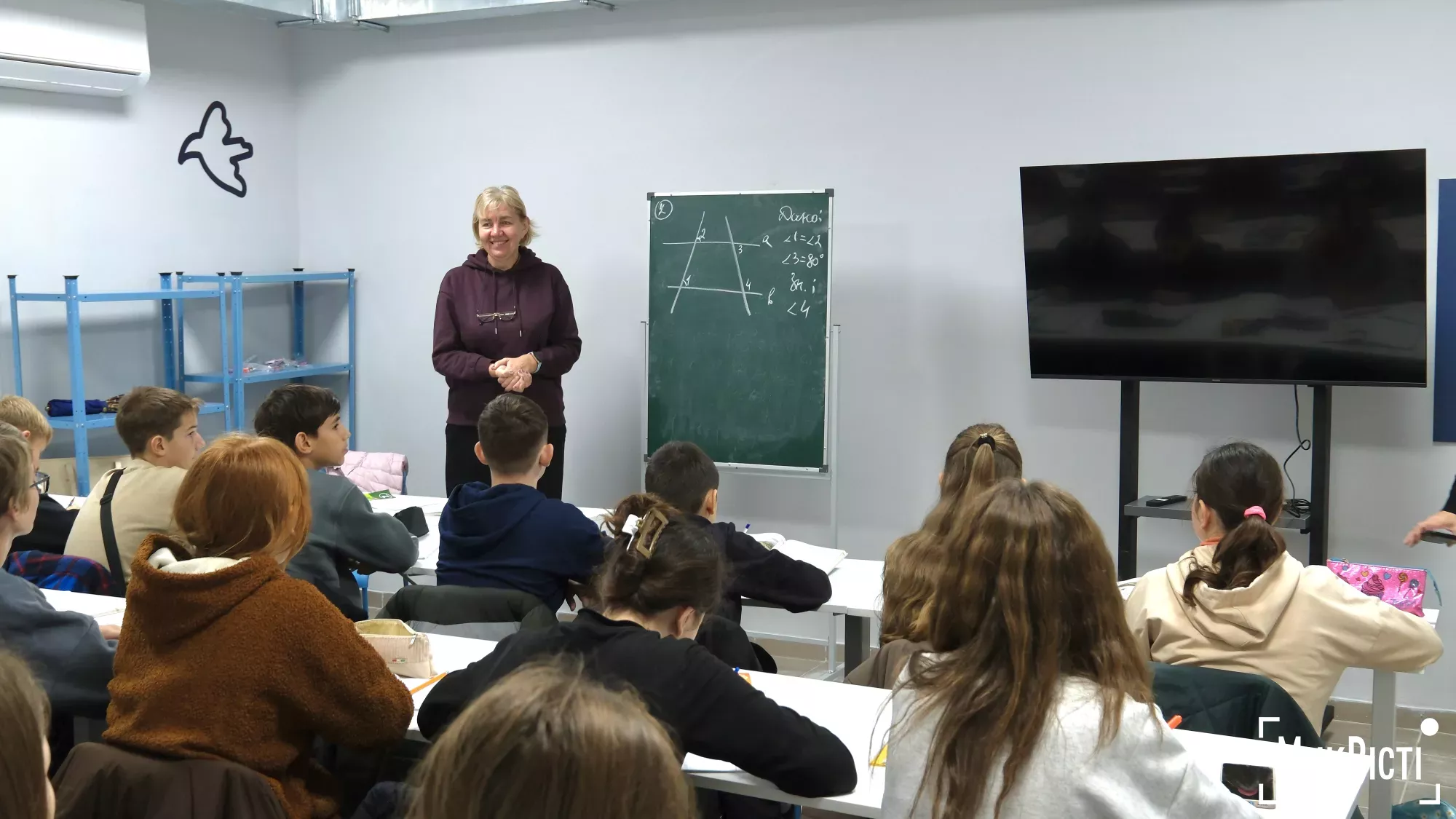 In Pervomaisk, children attend classes in cold classrooms. Photo: illustrative, NikVesti
In Pervomaisk schools, pupils attend classes in person despite low temperatures in classrooms, which sometimes drop to +6°...+11°. At the same time, the local commission on technological and environmental safety and emergencies has allowed in-person learning to continue with reduced lesson times.
Parents and teachers are reporting the cold in schools en masse on Facebook, according to NikVesti.
According to parents, the temperature in the gym of one of the schools is around +7°, and in classrooms — +8-10°. In schools No. 4 and No. 5, the temperature ranges from +6-8°, and in some lyceums — around +11°.
Low temperatures are also observed in kindergartens. Svitlana told NikVesti that in the Dyvohray kindergarten, when the lights are on, the temperature rises to +17° thanks to a heater. When the lights are turned off, the temperature drops, and children are forced to sleep in tights, sweaters and warm suits.
According to her, the generator is located right at the entrance to the kindergarten and has not been used for two years. When the prolonged power outages began, parents appealed to the acting director, but were told that no funds were allocated for fuel and that a collective appeal to the education department «made no sense».
«When the prolonged power outages began, parents asked the acting director of the kindergarten why it was not being connected. The first thing she said was that the generator had been allocated, but no funds had been allocated for fuel. However, we found out through our own channels that this could not be the case: if the equipment had been allocated, then fuel should also be provided. Then, when we wanted to write a collective appeal from the parents to the education department, we were told not to bother, because the department was aware of the situation and was allegedly taking measures. The generator is on the premises, covered with tarpaulin and propped up with wheels, but it is not running because it is not even connected. They explained to us that it would cost around 80-100 thousand hryvnias to connect it,» says Svitlana.
The situation is no better in schools, where the temperature drops to +12°C, children sit in jackets, hats and two pairs of socks, and lessons are reduced to half an hour. The education department refuses to switch to online learning, arguing that Zoom does not work without electricity.
«The situation is even worse at school, where the temperature can drop to 12°. Children sit in their coats, two pairs of socks and hats. Lessons are reduced to half an hour. We are now allowed to study at home because it is icy and cold outside, so my child is at home, but there are still 5-6 children sitting in class wearing gloves. The education department categorically refused to switch to online learning because they say they cannot use Zoom without electricity. The situation is dire. My son has chronic tonsillitis, and my daughter and I were hospitalised in Mykolaiv with severe pneumonia before New Year's Eve. We were barely able to recover. Taking a child out in such cold weather is simply terrifying. Many kindergartens in the city of Pervomaisk have the same story: they have generators, but they are not connected and do not work,» adds Svitlana.
Parents from other institutions also report problems. Maryna Zinkevych writes that generators were installed near schools and kindergartens several years ago, but they still haven't been connected. According to her, some of the funds that parents contribute to the school could be used to pay for fuel.
 Comments from residents of Pervomaisk about low temperatures in kindergartens and schools. Screenshots: Vadym Pidbereznyak
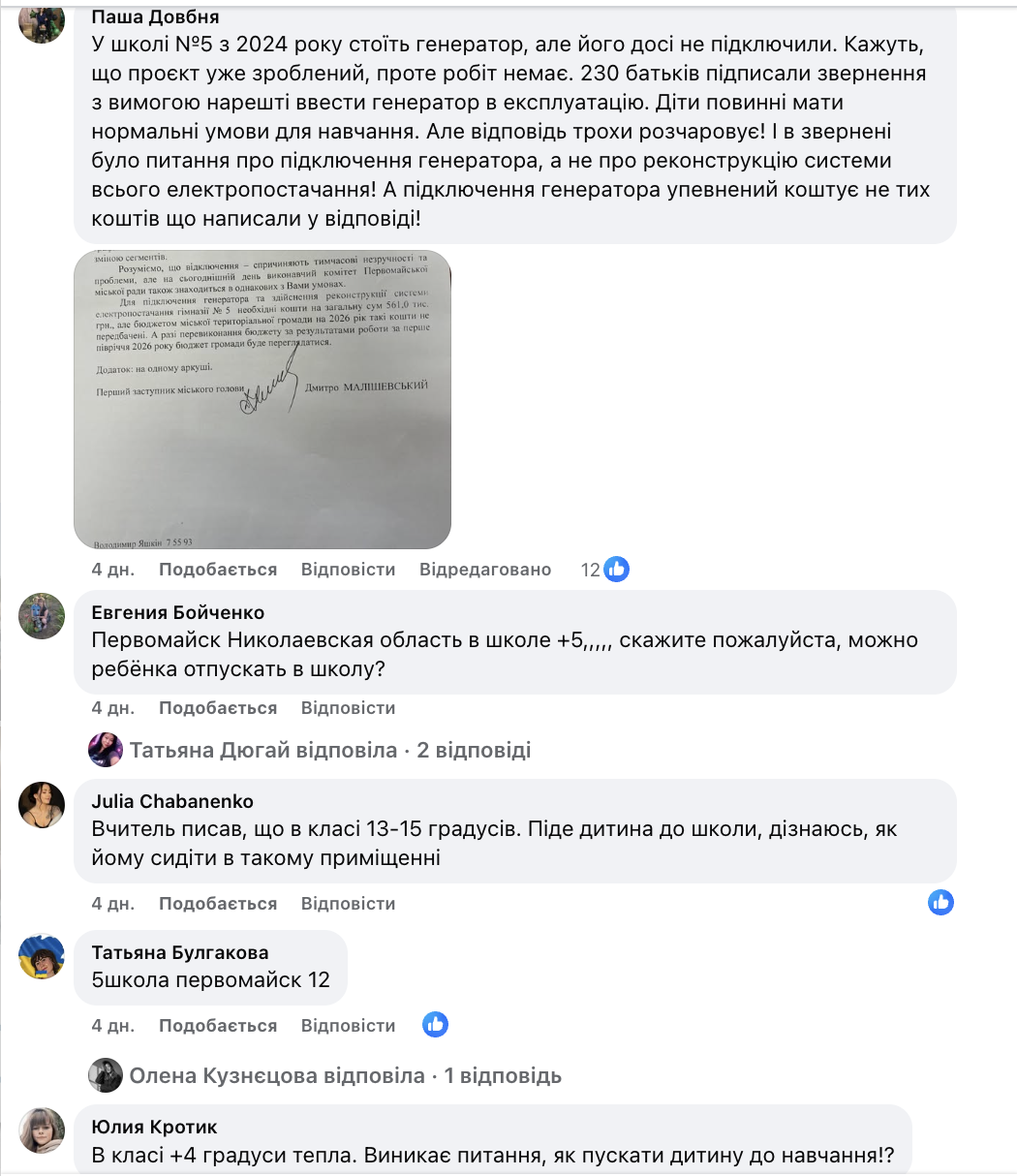 Comments from residents of Pervomaisk about low temperatures in kindergartens and schools. Screenshots: Vadym Pidbereznyak
In particular, parents of School №5 report that 230 people signed a petition demanding that a generator be put into operation, but received a response about the need to reconstruct the power supply system.
«School №5 has had a generator since 2024, but it has not yet been connected. They say that the project has already been completed, but no work has been done. 230 parents signed a petition demanding that the generator finally be put into operation. Children should have normal conditions for learning. But the response is a little disappointing! And the petition was about connecting the generator, not renovating the entire power supply system! And I'm sure connecting the generator doesn't cost as much as they wrote in their response!» writes Pasha Dovnia.
Nataliia Marianchuk adds that the temperature in the classrooms is around +11°C, and in the shelter it is +17-18°C, but it is impossible to accommodate the entire school there. A powerful generator has been standing in the courtyard for several years, but a project is needed to connect it. According to her, international funds could provide assistance, as they did in other cities in the region.
Former people's deputy and Pervomaisk resident Vadym Pidberezniak also stated that after his posts about the temperature in schools, he received a call from one of the educational institutions asking for help with fuel for the generator, which only had enough left for four days.
«After my latest posts, one of the directors asked for help with fuel for the generator, because there is only enough left for four days, and it is unclear what to do next. The education department believes that spring is coming soon and the issue will resolve itself,» wrote Vadym Pidberezniak.
He also emphasises that face-to-face learning continues even where attendance is only a third or a quarter of students, and online learning is impossible due to unstable power supply and lack of internet in schools.
«If the education department managers were doing their job, they would provide schools with fibre-optic internet with the ability to work from power banks. Instead, children are forced to study in person in cold classrooms,» adds Vadym Pidberezniak.
According to him, the school administration considers appealing to the education department to be a lengthy and ineffective process. He also notes that the decision to hold in-person classes is made even in conditions of icy roads, cold classrooms, and fuel shortages, and the internet in schools does not work during power outages. According to his estimates, only a third or a quarter of students are currently attending classes in some schools.
The education department explained that schools are heated using gas, electric, pellet and solid fuel boilers. Gas boilers are connected to 6-8 kW generators, which are supplied with fuel within the budget allocated by the city council.
The community also has 12 generators with a capacity of 50-100 kW, but only two of them are connected to the project. According to the department, there is not enough funding from the city budget for the rest.
The administration notes that every day by 8:30 a.m., they submit information about the temperature in schools to the mayor and contact the municipal enterprise «Zhytlo» regarding compliance with standards.
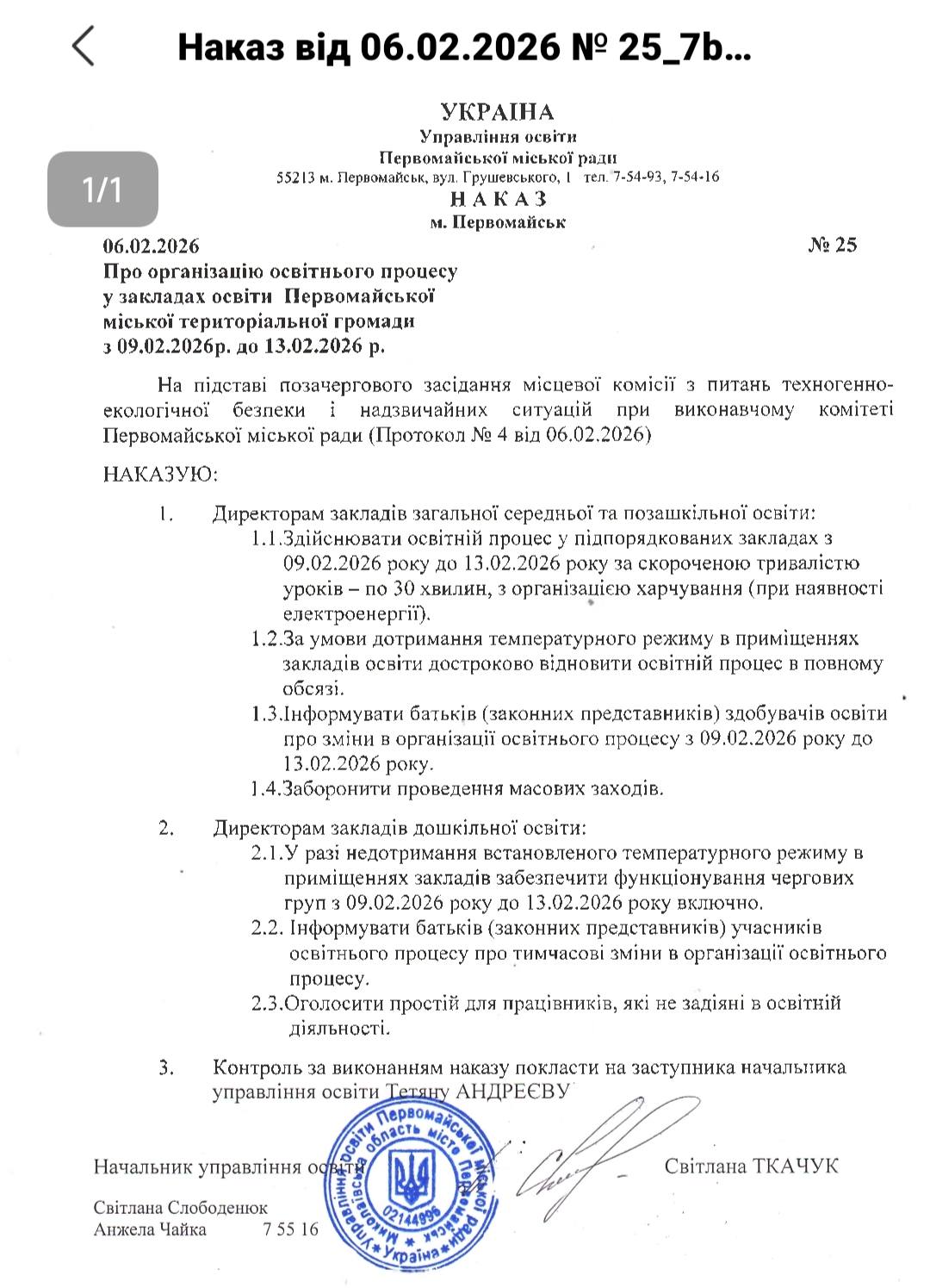 Decision of the TEB and NS Commission on in-person learning in Pervomaisk schools. Screenshots: Pervomaisk Education Department
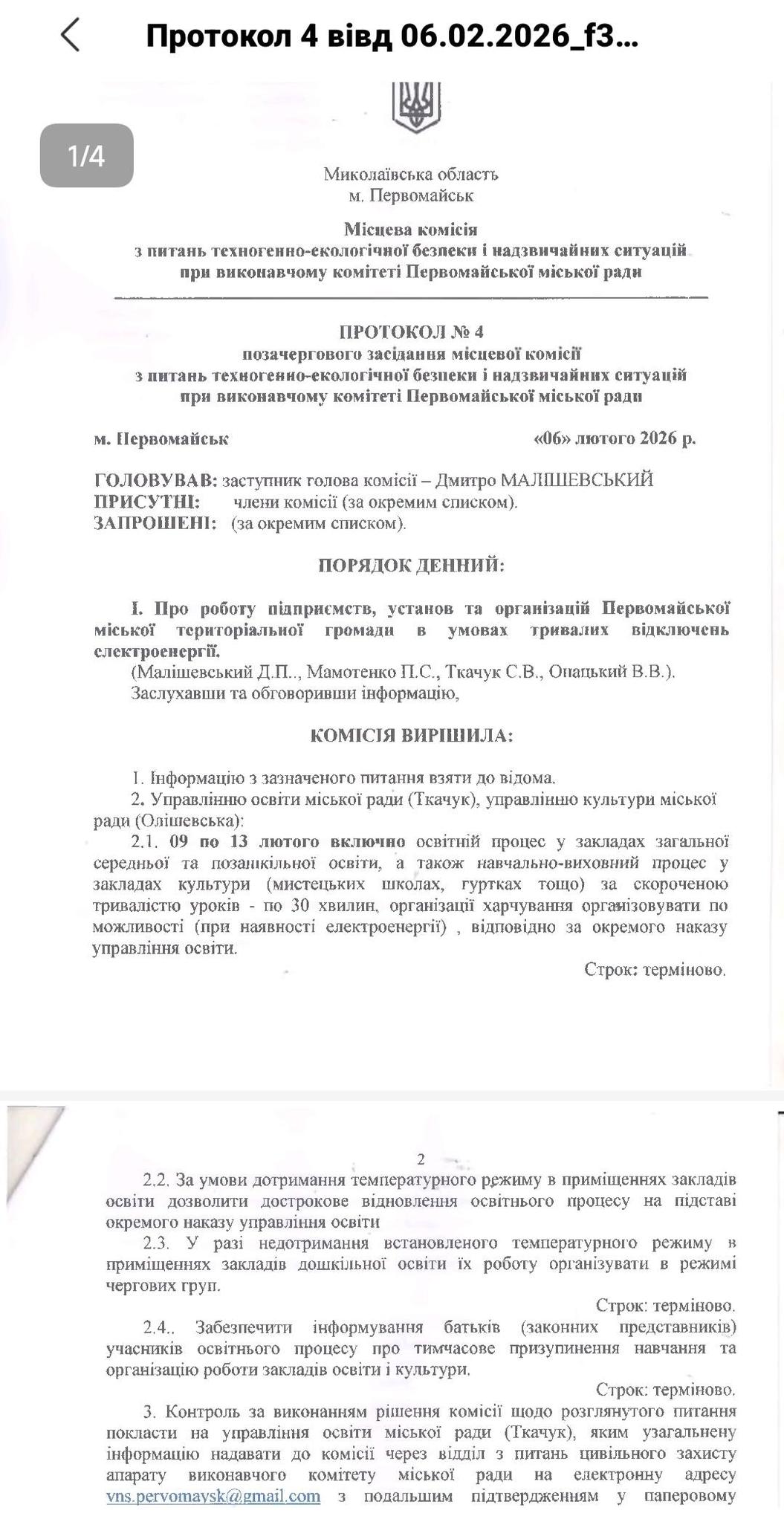 Decision of the TEB and NS commission on in-person learning in Pervomaisk schools. Screenshots: Pervomaisk Education Department
Despite this, from 9 to 13 February, general secondary and extracurricular educational institutions are operating in person. The relevant decision was made by the local TEB and NS commission. According to the recommendation, lessons are held for 30 minutes, and meals are organised when electricity is available. If temperature standards are not met in kindergartens, only on-duty groups are allowed to work.
Based on this decision, the Department of Education issued an order requiring school principals to inform parents about changes in the organisation of education and prohibiting mass events.
As is known, due to the sharp deterioration in weather conditions in January 2026, the Cabinet of Ministers recommended that educational institutions (schools, kindergartens, universities) switch to a remote format or extend the winter holidays until 19 January.
For example, on 2 February, educational institutions in Odesa temporarily switched to distance learning. This decision was made due to a significant drop in air temperature.

This material was produced within the REACH – Media Partnerships for Accountability and Trust project, implemented by International Media Support (IMS) and supported by the Ministry of Foreign Affairs of Denmark. The content reflects the views of the authors and not necessarily those of the Danish government. Denmark’s support strengthens civil society and independent media in Ukraine, including in Mykolaiv.

Чому ви читаєте «МикВісті»? Яка наша діяльність найбільш важлива для вас? Та чи хотіли б ви стати частиною спільноти читачів? Пройдіть опитування, це анонімно і займе 5 хвилин вашого часу