

Three months for a five-storey building: how destroyed houses are being demolished in Mykolaiv
- Alina KvitkoReporter
-
 20000 +
Incredible! This content has reached a new level — 20,000+ views!
20000 +
Incredible! This content has reached a new level — 20,000+ views!
-
 Prefer on Google
-
20K
Incredible! This content has reached a new level — 20,000+ views!
-
Prefer on Google
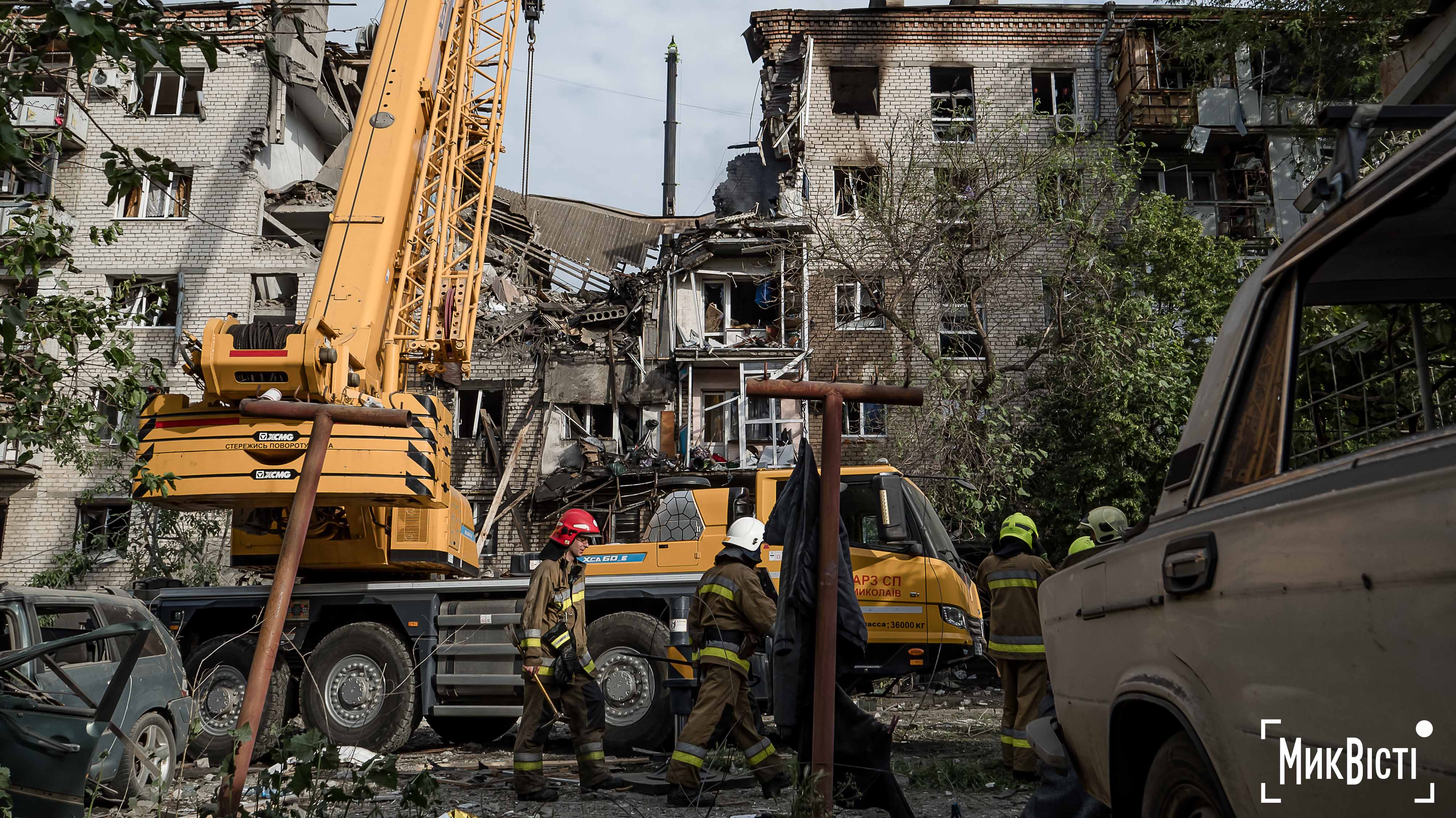 The building at 1 Obraztsova Street, destroyed by Russian shelling in 2025, is scheduled for demolition. Photo: NikVesti
In Mykolaiv, the demolition of war-damaged buildings has been ongoing for several years, but the scale of the work remains limited, and a significant portion of the sites are still only in the planning or approval stages. The city is gradually clearing the area of destroyed housing and infrastructure, but the process has proved more difficult and slower than expected due to bureaucratic procedures, the need for owner consent and dependence on international funding.
As of February 2026, 14 buildings have been officially designated for complete or partial demolition in the city. NikVesti analysed what has already been demolished, how much it costs, and which objects are next in line.
Three months for a five-storey building: how long does demolition take?
As of 9 February 2026, eight of the 22 buildings have been partially or completely demolished. The rest are in the queue, at various stages of approval or awaiting funding.
Not only residential buildings are being demolished, but also industrial premises, private garden houses, and infrastructure facilities. Some large public buildings are being demolished in stages.
Among public facilities, the Korabelnyi Cultural Centre at 328 Bohoiavlenskyi Avenue has been partially dismantled. The building, which was damaged during shelling, was dismantled by the contractor Energetychno-Dorozhne Budivnytstvo LLC with the support of UNDP. The exact cost of the work has not been disclosed, but some of the debris was not simply removed: concrete and stones were sorted and recycled into gravel and sand, while the rest was sent to the city landfill.
As explained by Vitalii Shevchenko, director of the municipal enterprise ELU Avtodorig, this practice reduces the load on the landfill and partially offsets the cost of removal. There are also plans to demolish part of the Mykolaiv Hotel, which was damaged during the shelling of the city.
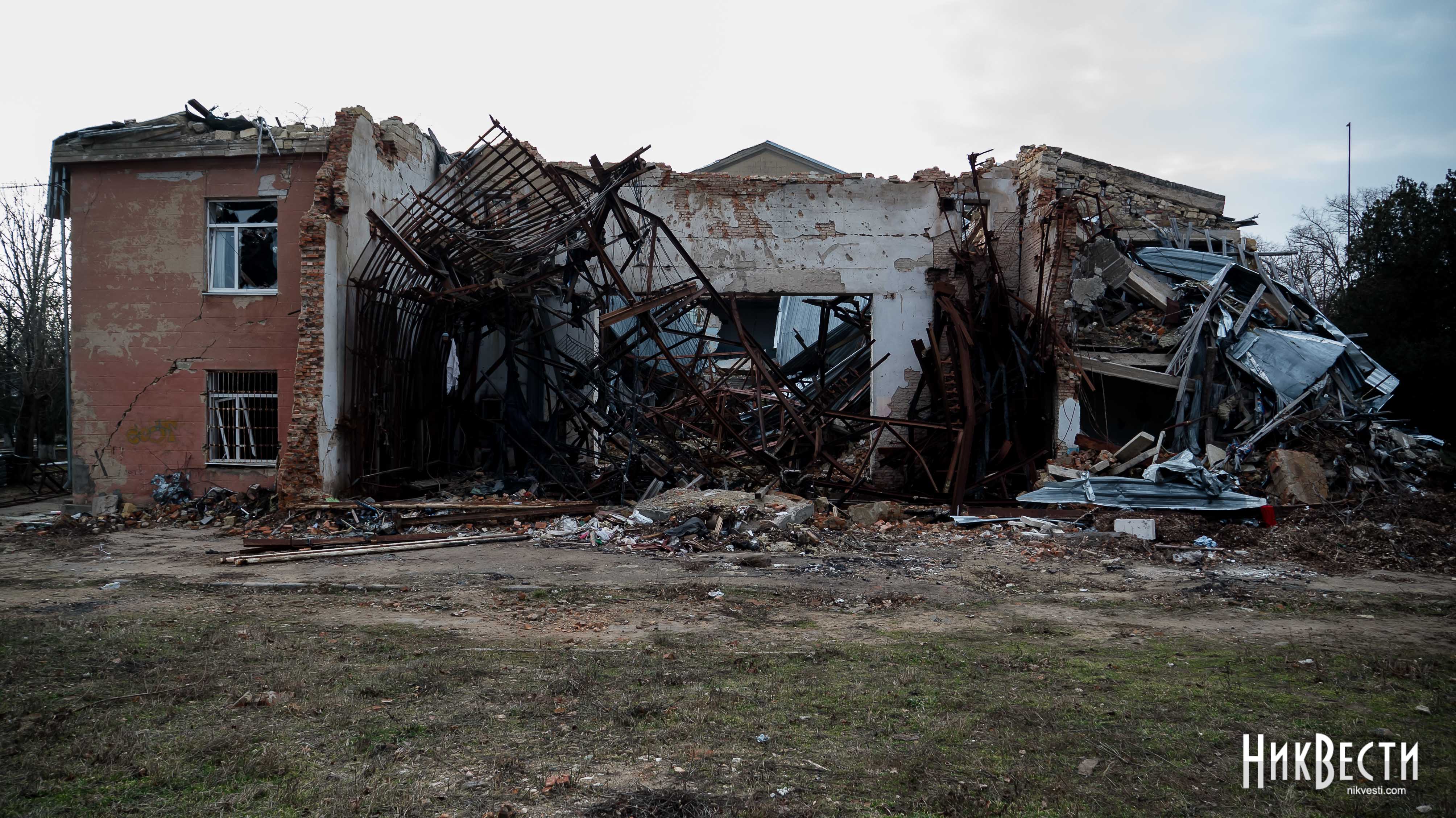 The destroyed part of the building where the assembly hall was located, photo: NikVesti
In total, 16.3 million hryvnias have been spent on demolition from the city budget since 2022. No funds have been allocated for this work in 2026. A significant part of the demolition work is actually being carried out thanks to international support. Most of the projects are financed by the United Nations Development Programme in Ukraine, which organises the demolition of individual residential buildings and infrastructure facilities. The city received the machinery and equipment for processing construction waste from JICA, USAID and UNDP.
The demolition process itself is much more complicated than it seems. Before a building can be physically dismantled, it must be legally prepared for demolition.
First, a technical survey is conducted to confirm that the structures are dangerous or cannot be restored. Then, the issue is considered by the regional commission on technological and environmental safety and emergencies (TES and ES). After that, a decision is made by the executive committee of the city council.
Ihor Nabatov, deputy director of the Housing and Utilities Department, explains that the basis for the executive committee's decision on demolition is the decision of the TES and NS commission. After that, demining reports are drawn up — separately by the State Emergency Service and the National Police.
In one case, he says, rescuers found a grenade before starting work at 43 Pohranychna Street.
«I don't know how it got there, but they found a grenade. It was inactive, but they found a grenade. It shouldn't just lie on the street,» said Ihor Nabatov.
 In 2024, builders demolished the building at 43 Pohranychna Street in Mykolaiv, photo: NikVesti
In addition, the necessary documents for disconnecting electricity, gas and water supplies, as well as sewage, must be obtained, and only then can the demolition itself begin.
But even at this stage, work may be halted. For apartment buildings, the consent of the co-owners is mandatory. If some of the residents oppose the demolition or cannot be found, which often happens due to the owners' departure to safer regions, the process effectively stalls.
Although Resolution №474 stipulates that the decision on demolition is made by the executive committee, the law on the regulation of property rights speaks of the decisive role of the owner. Due to this legal conflict, the city actually adheres to both norms — it obtains the decision of the executive committee and the written consent of the co-owners.
«Consent to dismantling from owners, both for commercial properties and multi-apartment residential buildings, is a very important point because it is not directly specified in Resolution №474, but it is mentioned in the law on the regulation of property activities, which states that the decision on dismantling is made by the owner. Although Resolution №474 states that the decision on dismantling is made by the executive committee. In fact, we comply with both norms and obtain the relevant decision from both the executive committee and the owners,» says Ihor Nabatov.
It is easier with businesses: the company makes a decision, and the procedure moves forward. However, the situation is more complicated with apartment buildings. If there is not 100% agreement, the work does not begin.
When expertise is stronger than resistance: the stories of buildings on Krylova and Aliaudy
The building at 54 Krylova Street and the high-rise buildings at 2 and 3 Aliaudy are officially subject to demolition. The decision is based on technical reports that found parts of these buildings unfit for habitation.
These stories are united not only by the consequences of Russian strikes, but also by the difficult dialogue with residents who for years did not give their consent to demolition.
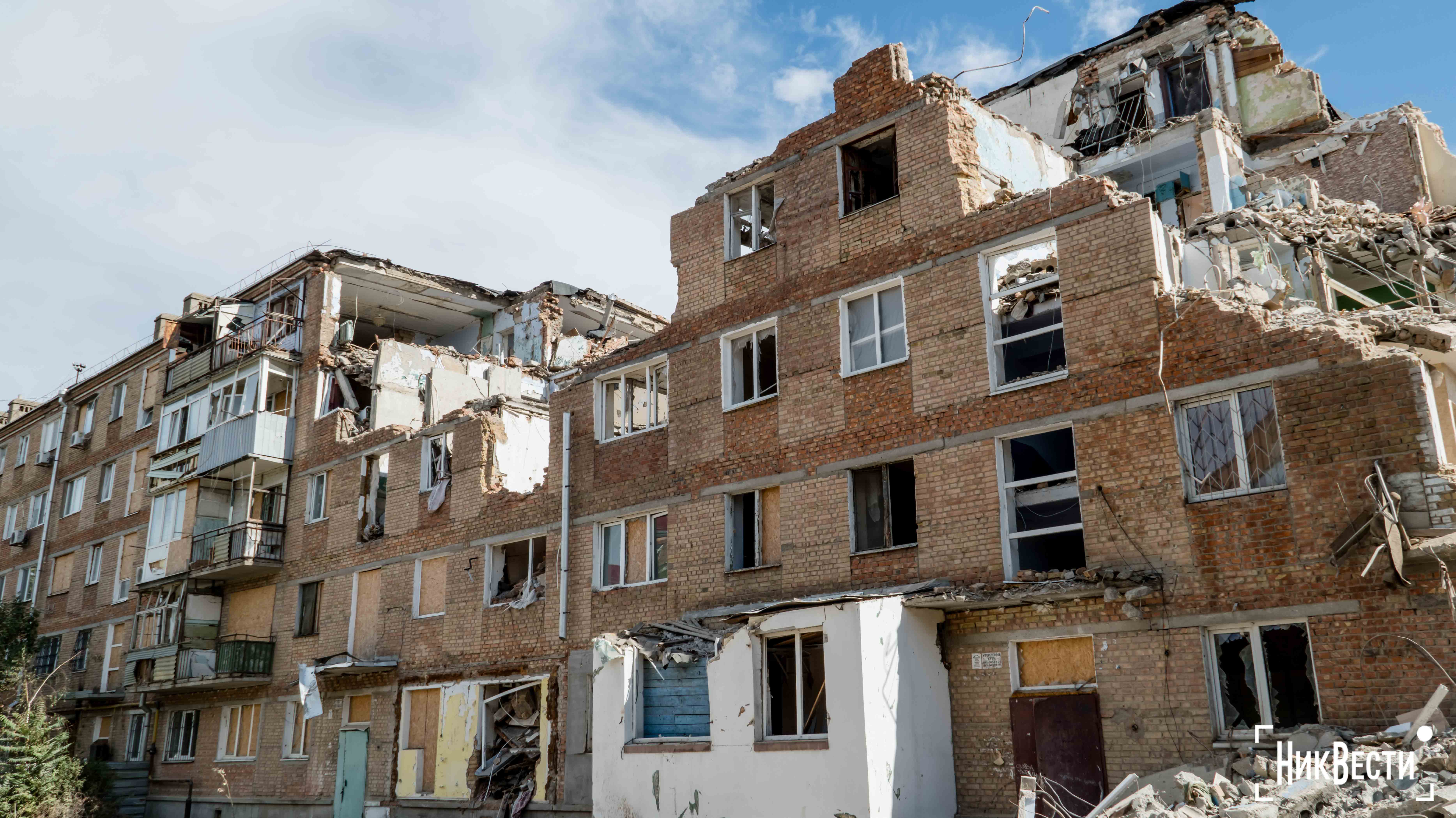
Ihor Nabatov explains that in the case of 54bKrylova Street, the city was unable to move forward for a long time due to the lack of consent from the co-owners. Some people hoped for restoration and did not believe they would be able to receive compensation.
 Damaged entrance to a building on Krylova Street in Mykolaiv, photo: NikVesti
According to him, to date, there have been no cases where the city has gone to court for forced demolition. According to Ihor Nabatov, potentially conflictual situations were resolved in other ways.
«To date, there have been no such cases. All potentially conflictual situations have been resolved in other ways. Usually, people do not agree to demolition because they do not believe they will receive any compensation,» explains Ihor Nabatov.
He emphasises that the key document is not the demolition report, but the technical report. It is the expert opinion on the need for demolition that gives the right to a housing certificate.
In the case of 54 Krylova Street, the situation was resolved by the third and final technical report. It stated that the seventh entrance could not be used for residential purposes. As a result, all residents of this entrance were entitled to compensation in the form of housing certificates.
«When we received the third technical report, the final one, it seemed to dot all the i's and cross all the t's. The technical report stated that the entire seventh entrance was entitled to compensation in the form of certificates, because the entire seventh entrance was recognised as unfit for habitation,» says Ihor Nabatov.
After that, people decided for themselves whether to exercise their right or not. In other words, the decision to demolish and the right to compensation were legally separated: first, the building was recognised as unsafe on the basis of the report, and then the possibility of receiving a certificate.
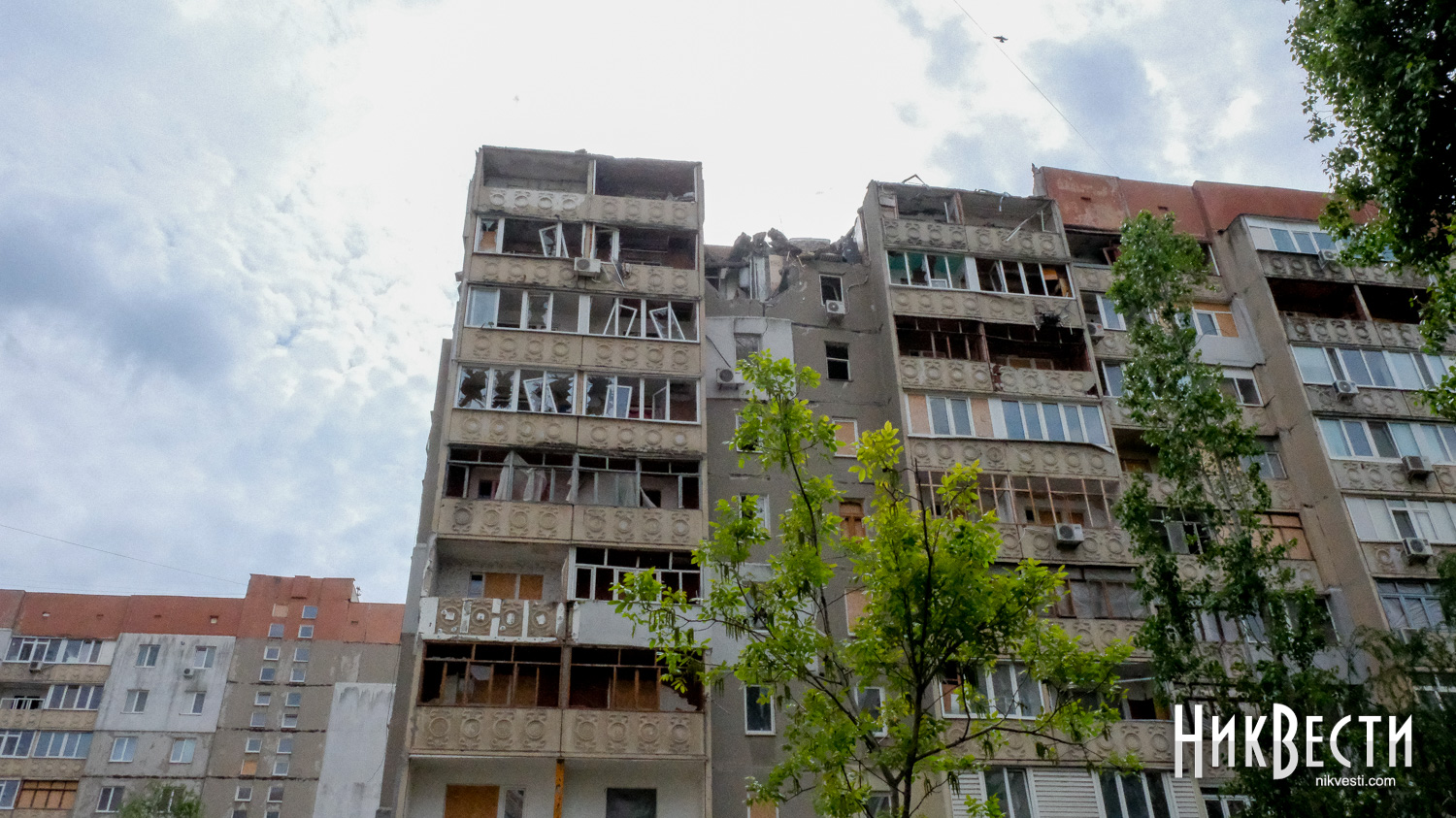
A similar procedure applies to buildings at 2 and 3 Aliaudy. According to Ihor Nabatov, technical reports also confirmed that these buildings cannot be used for long.
At the same time, some residents continue to live in their flats and refuse to leave. The city has no right to forcibly evict people if they remain in their homes.
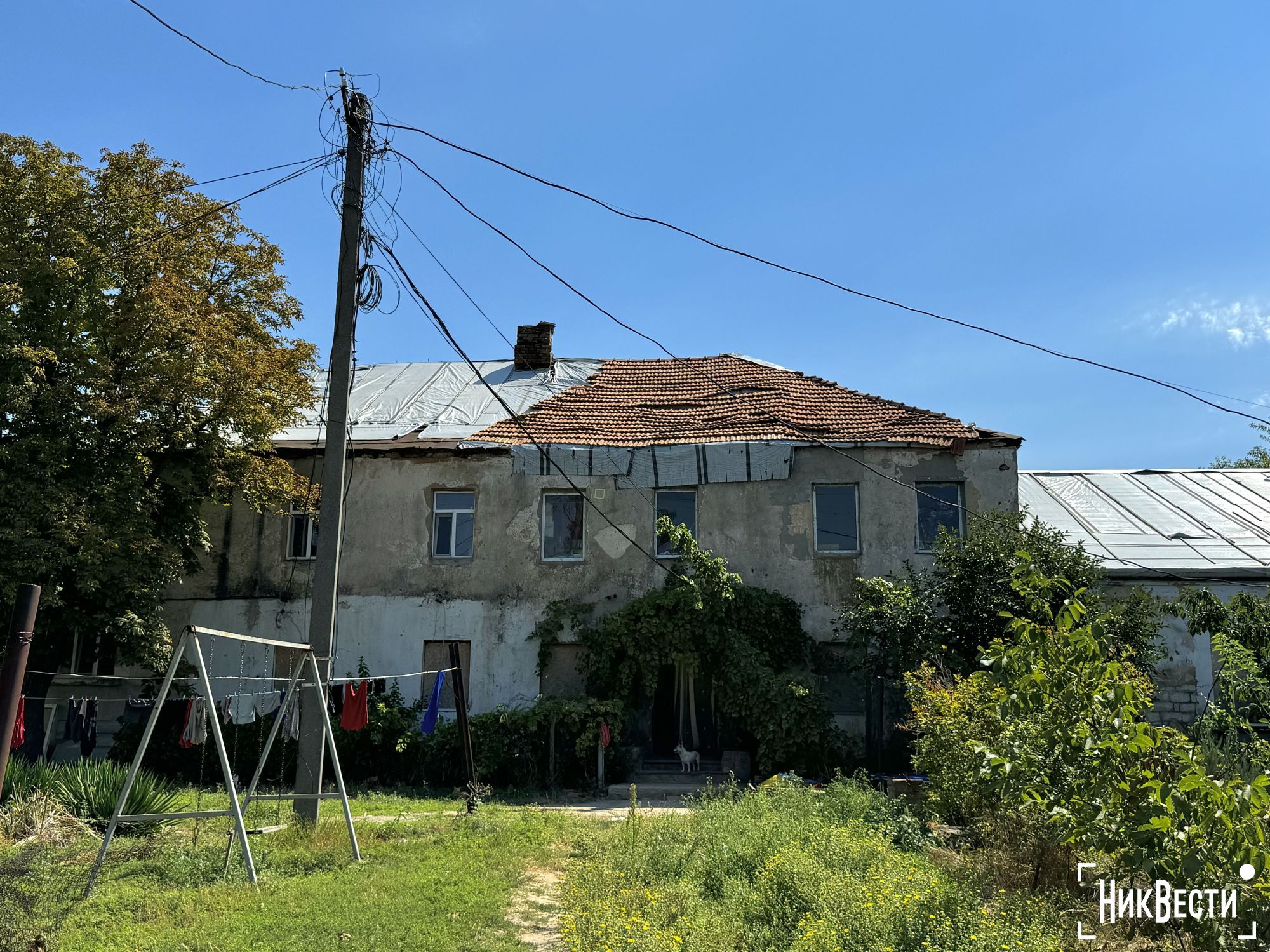 A building damaged by shelling at 2 Alyaudy Street in Mykolaiv. Photo: NikVesti
Ihor Nabatov notes that these buildings were old even before the shelling, and the damage has only worsened their condition. At the same time, the expert assessment indicates that the structures cannot stand for long, so the owners have the right to use the mechanism for obtaining certificates.
«The building at 2-3 Aliaudy Street. The same situation, the building has not been demolished, and some people even continue to live there. In principle, these were quite old buildings, but the damage caused by the armed aggression only finished them off. But if someone continues to live there, that is their right. We cannot evict anyone. Theoretically, we see that people live there and there is no such danger. But the technical report says that this object cannot stand for long, and the owners are actually exercising their right to obtain a certificate,» says Ihor Nabatov.
The property status creates a separate complication: there are many non-privatised flats in the buildings on Aliaudy, and the housing stock itself is state-owned. This complicates the approval procedures and delays the demolition process.
A similar situation exists at 119 Slobidska Street. There is a technical report, but there is no full agreement among the co-owners on demolition. Despite this, residents who are eligible are already receiving certificates.
It is because of these legal nuances that there are buildings in the city that are officially recognised as unsafe and subject to demolition, but remain in place for years. Some residents do not agree to demolition, some continue to live in damaged flats, and sometimes it is impossible to identify the owners at all — especially if the property has not been privatised or the owners have moved out.
Once all approvals have been obtained, demolition begins directly on site. This is also a complex technical operation. According to experts, the complete demolition of a typical five-storey building, including the removal and sorting of materials, takes approximately three months.
«Based on our experience in 2023–2024, the demolition of a five-storey building, such as at 35 Zavodska Street, buildings 1, 3 and 5, takes about three months — from arrival to complete completion and cleaning of the site. It can be a little faster or longer, as many factors influence the process. For example, in order to start demolition, it is necessary to collect a mandatory set of documents, which is required both by us as customers and by the UNDP, which finances projects throughout Ukraine, including in the Mykolaiv region,» says Ihor Nabatov.
Chronicles of dismantling: What has already disappeared from the city map?
To date, eight buildings have been partially or completely demolished.
Completely dismantled buildings:
-
35/1 Zavodska Street — dismantled in December 2023, at a cost of 1.9 million hryvnias.
-
35/3 Zavodska Street — December 2023, cost 1.7 million hryvnias.
-
35/5 Zavodska Street — December 2023, cost 5.3 million hryvnias.
-
6 Oleksandra Klepikova (Lohovenka) Street — May 2024, cost 4.4 million hryvnias
-
49 B-1 Velyka Morska Street — July 2023, cost 146,300 hryvnias.
Partial demolition (entrances or individual flats):
-
13 Vadym Blahovisnyi Street (Nikolska Street) — partial demolition of apartments №11, 12, 13, 26 in December 2023, cost 533,200 hryvnias.
-
49/1 General Oleksa Almazov Street (General Karpenko Street) — partial demolition of the 4th entrance in December 2023, cost 2 million 89 thousand hryvnias.
-
13 Vadym Blagovisnyi Street (Nikolska Street) — complete demolition of apartment №14 in August 2023, at a cost of 115,100 hryvnias.
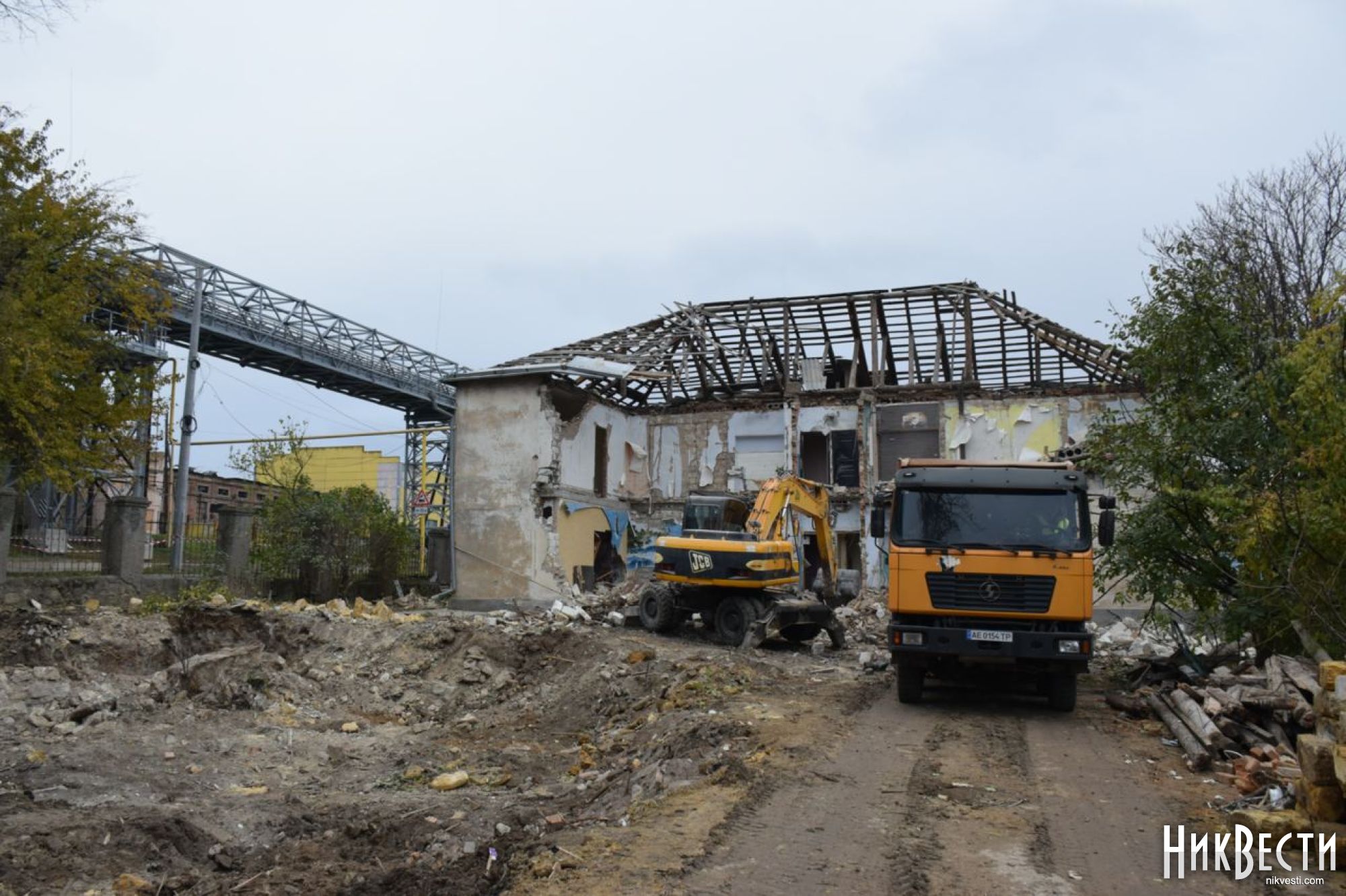 Demolished building at 35 Zavodska Street. Photo: NikVesti
Demolitions supported by UNDP
43 Pohranychna Street — partial demolition of the 3rd and 4th entrances in October 2024. The work was carried out at the expense of the United Nations Development Programme (UNDP) in Ukraine. The estimated cost was 5.4 million hryvnias.
According to the United Nations Development Programme, the contractor, Energetychno-Dorozhne Budivnytstvo LLC, carried out demolition work on other sites. These include:
-
Civil facility at 43A/9 Bohoiavlenskyi Avenue — complete dismantling with removal of construction waste.
-
Production premises at 15 Prymiska Street — partial dismantling.
-
Industrial premises at 5A Starofortechna Street (ONIKS LLC) — partial dismantling.
-
Private houses at 22 Yevhen Malaniuk Street, 37 Garazhna Street, and 92 Lytovchenko Street — complete demolition.
-
Private garden house at 61 Komunar Street, 86 — complete demolition.
-
Partial demolition on the territory of the Mykolaiv Vegetable Base and Korabelnyi.
No information was provided on the cost of this work.
«It should also be noted that some houses have a decision by the executive committee on demolition, but without the consent of the owners, the process is impossible. If there is consent, we provide a list of such objects to the UNDP for procurement,» said Ihor Nabatov.
UNDP works not with individual buildings, but with the scope of work. For each building, the approximate extent of the damage is determined in conjunction with the administration and then forwarded to UNDP. Sometimes, because procurement is carried out throughout the region, some buildings may be left off the list or added to it later if other donors join the demolition process or communities carry out the work themselves.
Plans for 2026: what will be demolished first?
According to the Housing and Communal Services Department, three priority demolition projects have been identified for 2026 under the new contract with UNDP. These include:
-
54 Krylova Street — a building that has previously caused controversy. Priority work is planned.
-
The Mykolaiv Hotel in the city centre — partial demolition is planned. The owners have already given their consent and are awaiting assistance.
-
1 Obraztsova Street — a residential building.
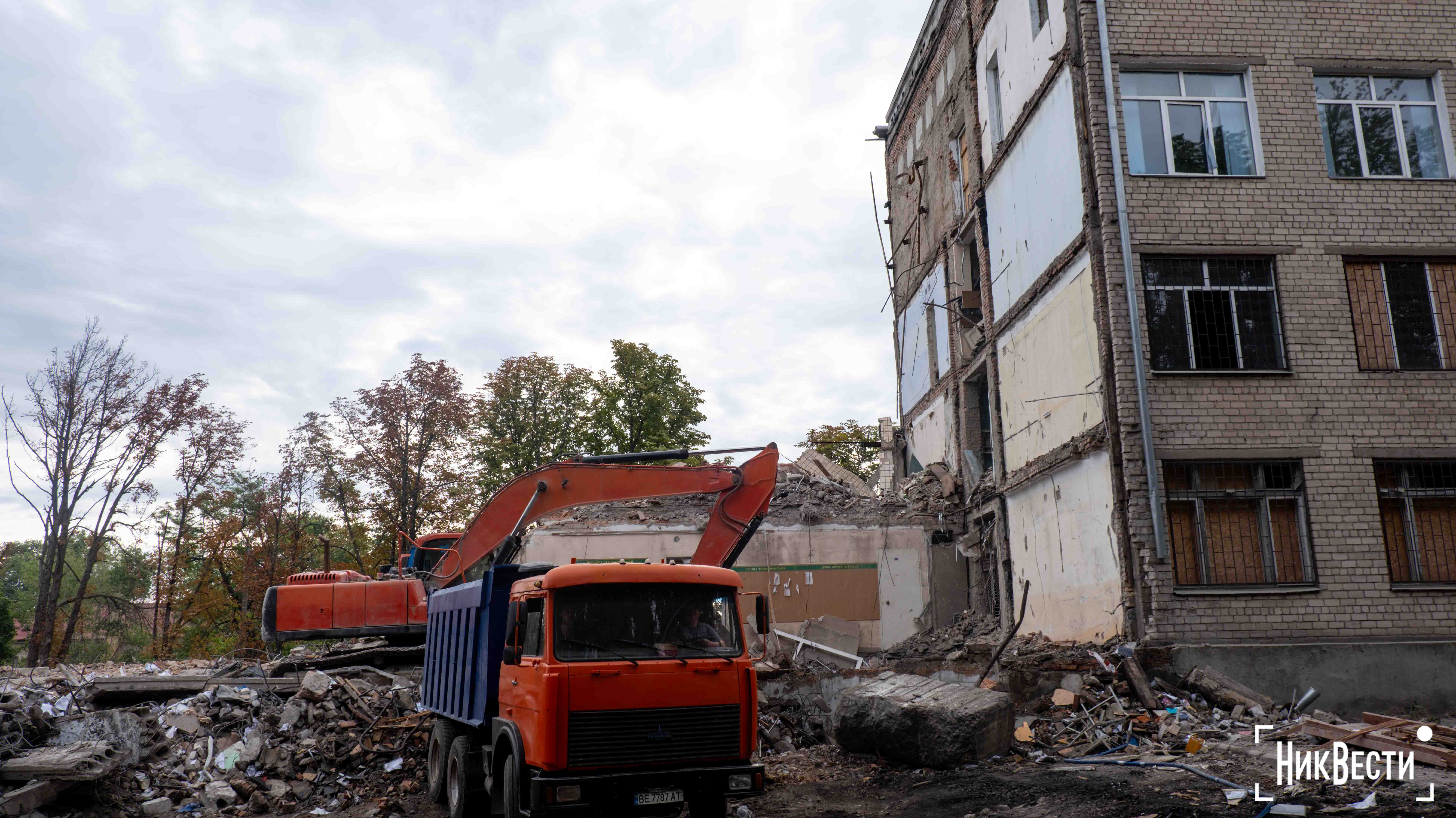 Demolition work on the territory of V.O. Sukhomlynsky University, photo: NikVesti
A request has also recently been received regarding the further demolition of buildings at Sukhomlynskyi University (now part of Admiral Makarov National University of Shipbuilding).
«A request was recently received by the mayor from the Admiral Makarov National University of Shipbuilding, which now includes the Sukhomlynskyi Mykolaiv National University following the merger. The UNDP already worked on this site (Sukhomlynskyi University) in 2024, carrying out partial demolition, but additional work needs to be done on some buildings. We have now received a request to this effect. We were informed by telephone that they have all the documents, including the technical report. If everything is in order with the documents, we will be able to propose to include this facility in the list for dismantling — if they (UNDP, — note) have such an opportunity,» says Ihor Nabatov.
According to Ihor Nabatov, deputy director of the Housing and Utilities Department, the first phase of work is planned to begin at 54 Krylova Street due to the public outcry surrounding this building, and then the demolition of part of the hotel and the building on Obraztsova Street will begin. The contract with UNDP is valid until June, so the work is expected to be completed in the near future.
Demolition of part of the Mykolaiv Hotel: what is known and when will the work begin
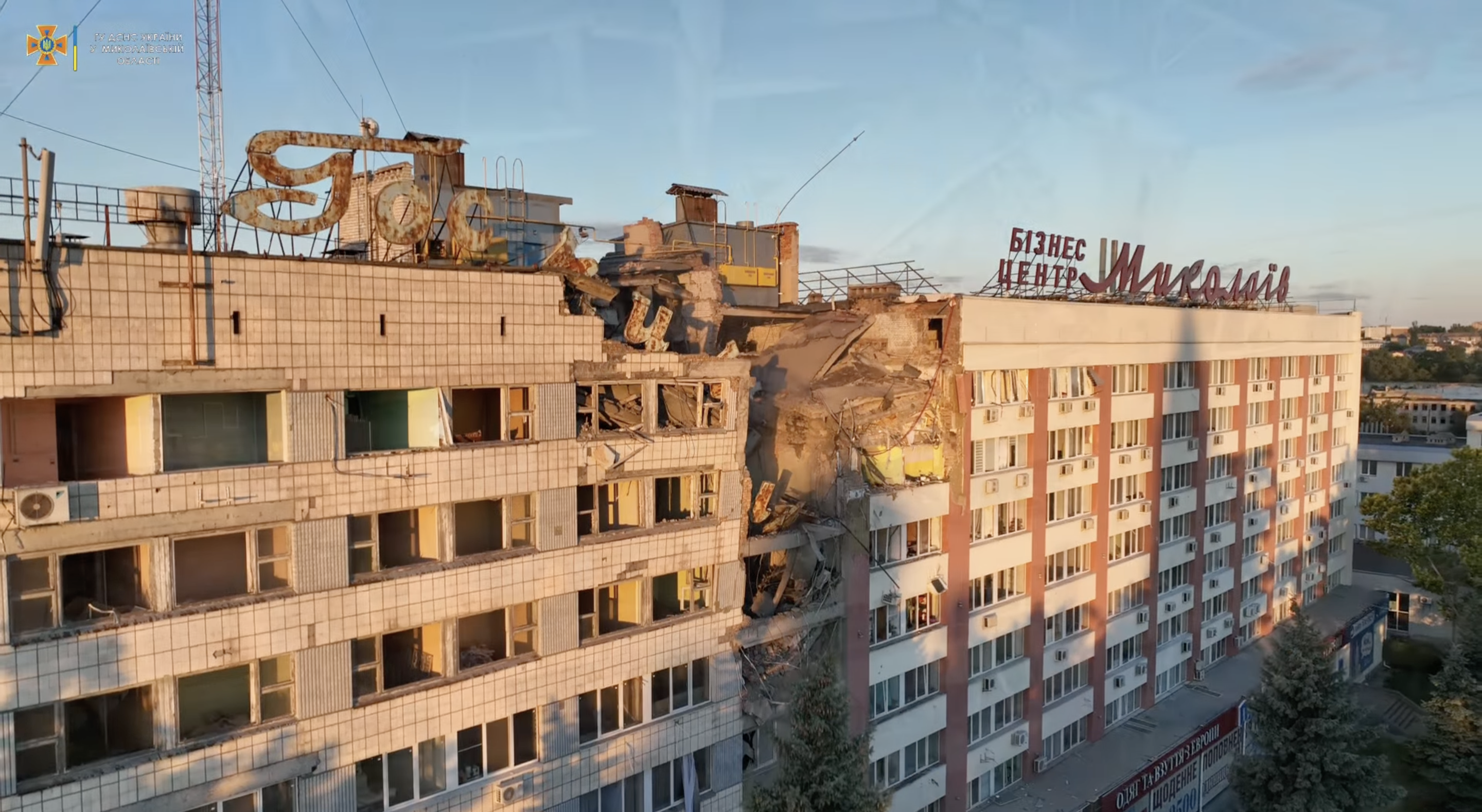 The destroyed building of the Mykolaiv Hotel, photo: State Emergency Service
The Mykolaiv Hotel, damaged by a rocket strike in 2022, is being prepared for partial demolition. The work will take place after the preparation of documentation that will ensure the safe reinforcement of the remaining building.
«Demolition is not a simple procedure. It is carried out on the basis of special demolition documentation — a large package of documents without which it is impossible to start work. It is necessary not only for the demolition process itself, but also to ensure the safe and normal operation of the facility both during demolition and after its completion. All these requirements and technical solutions are recorded in the documentation, which must be approved by the owner of the facility, among others,» says Ihor Nabatov.
The hotel has two owners who are willing to cooperate, but the city needs help specifically with organising the demolition. It is too early to talk about further restoration.
Regional Council building: search for an international solution
After a rocket strike in the spring of 2022, the Mykolaiv Regional Council building was effectively rendered unusable. In October 2023, deputies decided to write off the property and gave their consent for its demolition. The document also stipulated that the Mykolaiv Regional Military Administration should allocate funds in the budget for the development of project and cost estimate documentation.
As explained by the head of the regional council, Anton Tabunschyk, it has been decided not to return to this idea at present. Given the high cost of both the documentation itself and the future work, there are currently no plans to finance a separate stage of design and estimate documentation development.
Instead, the region, together with the Regional Military Administration, is working with international partners. According to Anton Tabunschyk, they want to take a broader approach — not just plan for demolition after the war ends, but immediately think about what will appear on this territory next.
This involves developing options for new construction on the site of the destroyed building. In other words, the issue of demolition is being considered in conjunction with the future use of the site, rather than as a separate process.
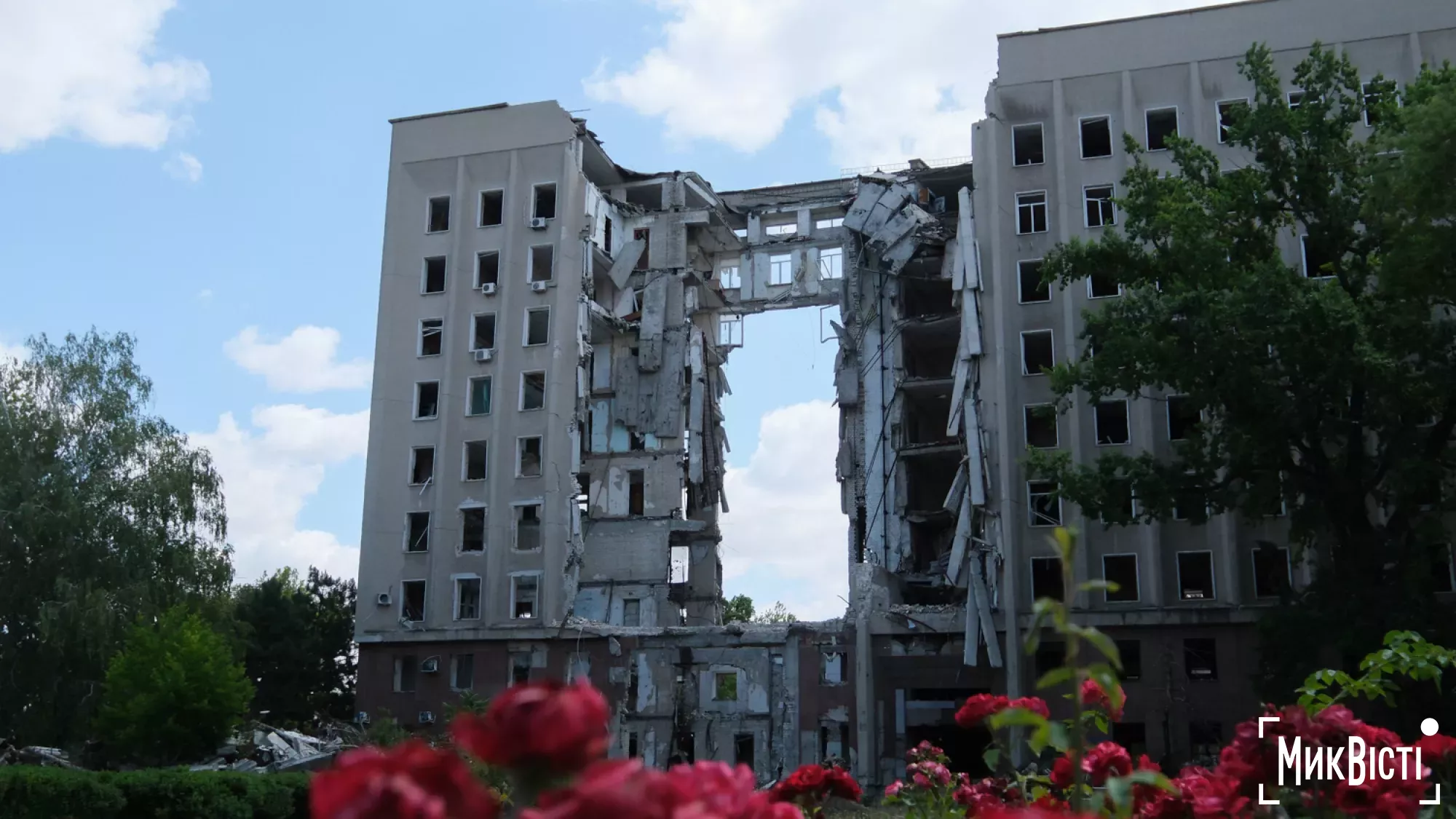 The destroyed building of the Mykolaiv Regional State Administration, June 2025. Photo: archive NikVesti
What happens to the land after the buildings are demolished
If a building is demolished, the process of providing people with access to their homes is organised through cooperation between the client, the contractor and the co-owners of the building.
The most recent example is 4 Pozdovzhnia Street, 87. According to Ihor Nabatov, although the demolition there was not the result of armed aggression, it was partial, and the contractor is obliged by contract to ensure that people can collect their belongings.
«This is done by checking the building's structure for accessibility and accompanying people to their homes to collect their belongings. The contractor removes household appliances, furniture and other items requested by residents and places them near the entrances. People already know about this, take their belongings and transport them away,» says Ihor Nabatov.
As for the future of the land after demolition, the situation depends on urban planning documentation. For example, on Zavodska Street, residential buildings could not actually exist in this area, and there will be no new residential buildings there, especially on the plots at 35 Zavodska street, buildings 1, 3 and 5, due to numerous complaints about the location next to the terminal.
As for other buildings, such as 6 Lohovenka Street or private houses in the city, the land plot has the status of residential development. It can only be changed under certain conditions, for example, when the concept of the microdistrict is changed, but so far, according to Ihor Nabatov, no such changes have been made.
The partial demolition of other buildings does not affect the intended use of the land plots.
Demolition in Mykolaiv is a slow, complex and sometimes controversial process. Each building requires approvals, expert assessments and the consent of the owners before the equipment can enter the site. But step by step, the city is clearing the space of dilapidated housing, paving the way for new projects and safe living.

This material was produced as part of the "Improving Ukrainian Media Resilience" project, implemented by the Fondation Hirondelle (Switzerland) and IRMI, the Institute for Regional Media and Information (Ukraine). The project is funded by Swiss Solidarity.


Чому ви читаєте «МикВісті»? Яка наша діяльність найбільш важлива для вас? Та чи хотіли б ви стати частиною спільноти читачів? Пройдіть опитування, це анонімно і займе 5 хвилин вашого часу