
The Mykolaiv Housing and Communal Services Department believes that the tariff for building maintenance should be increased from ₴5 to ₴12 per m²
- Alina KvitkoReporter

 Volodymyr Nikolaichuk, Head of the City’s Sustainable Development Division within the Department of Urban Services of the Mykolaiv City Council. Photo: NikVesti
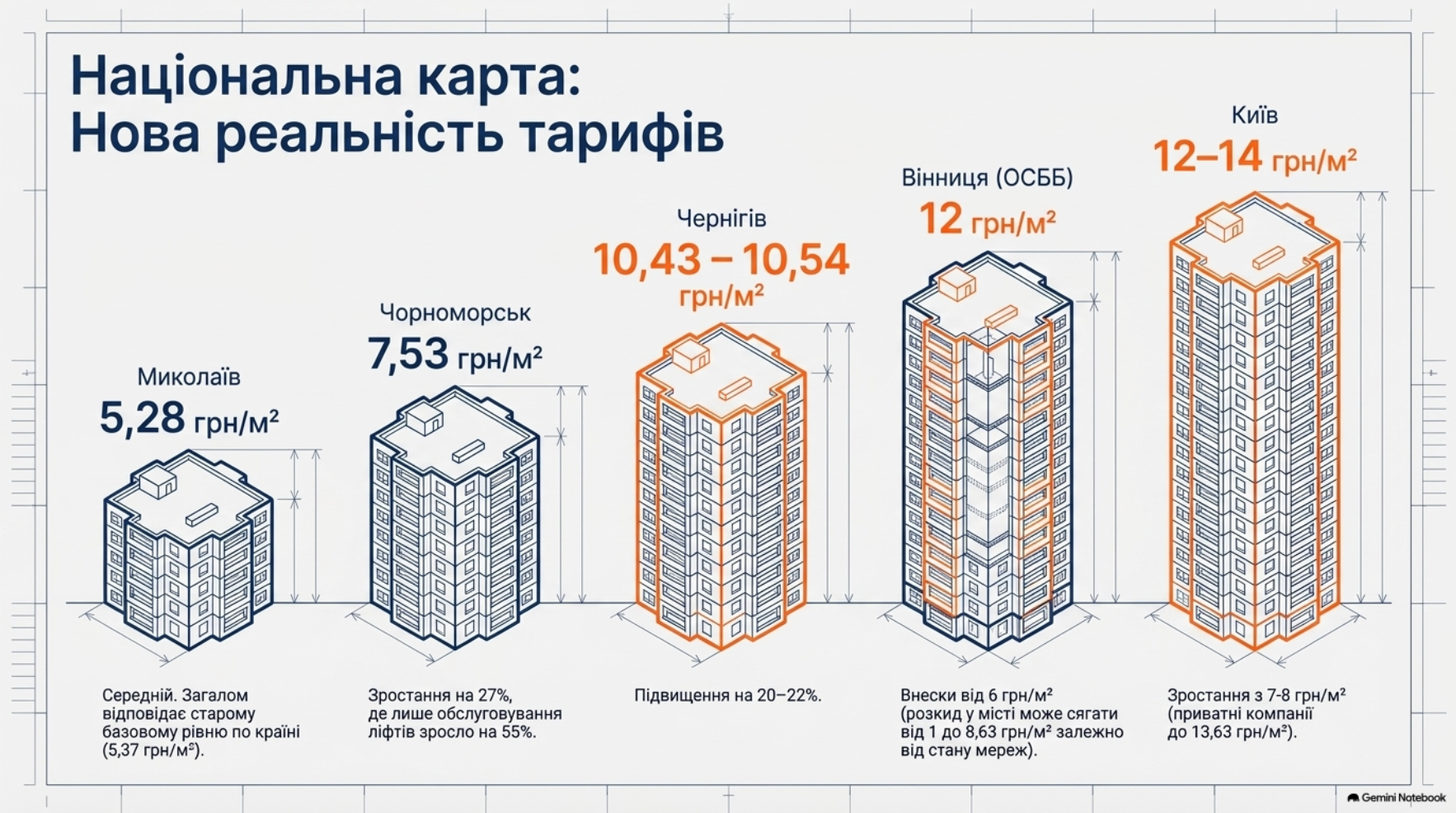
In Mykolaiv, the average fee for the management of apartment blocks is 5.28 hryvnias per square metre; however, for the building to be properly maintained in accordance with regulations, it should be at least 12 hryvnias. That said, the specific amount for each building must be determined individually by its residents, depending on the building’s condition, floor area, surrounding grounds and the list of necessary works.
This was announced during a city briefing by Volodymyr Nikolaichuk, head of the City’s Sustainable Development Division within the Department of Municipal Services of the Mykolaiv City Council, according to NikVesti.
In Mykolaiv, the average tariff for the management of multi-apartment buildings is 5.28 hryvnias per square metre. At the same time, an economically justified tariff for the routine maintenance of a building should currently be at least 12 hryvnias per square metre.
However, this does not mean setting a single rate for all buildings. According to Volodymyr Nikolaichuk, the specific amount should depend on the characteristics of each building, its condition, the amount of work required, the size of the surrounding grounds and other costs.
«Yes, you are correct in understanding that the tariff needs to be increased. Each building must work out for itself what specific amount this should be, taking economic factors into account,» said Volodymyr Nikolaichuk, responding to a question about the need to raise the tariff to 11–12 hryvnias.
According to him, the current average tariff in Mykolaiv is 5.28 hryvnias per square metre, whilst in different blocks of flats it ranges from approximately 3 to 9 hryvnias.
«What is the current situation in Mykolaiv? 5.278 hryvnias per square metre is the average tariff for the management of apartment blocks across Mykolaiv. In other words, it currently varies from 3 hryvnias to 9 hryvnias and a few kopiikas,» explained Volodymyr Nikolaichuk.
 What you need to know about maintenance fees for high-rise blocks. Photo: Infographic by the Department of Municipal Services of Mykolaiv City Council
Who sets the fee
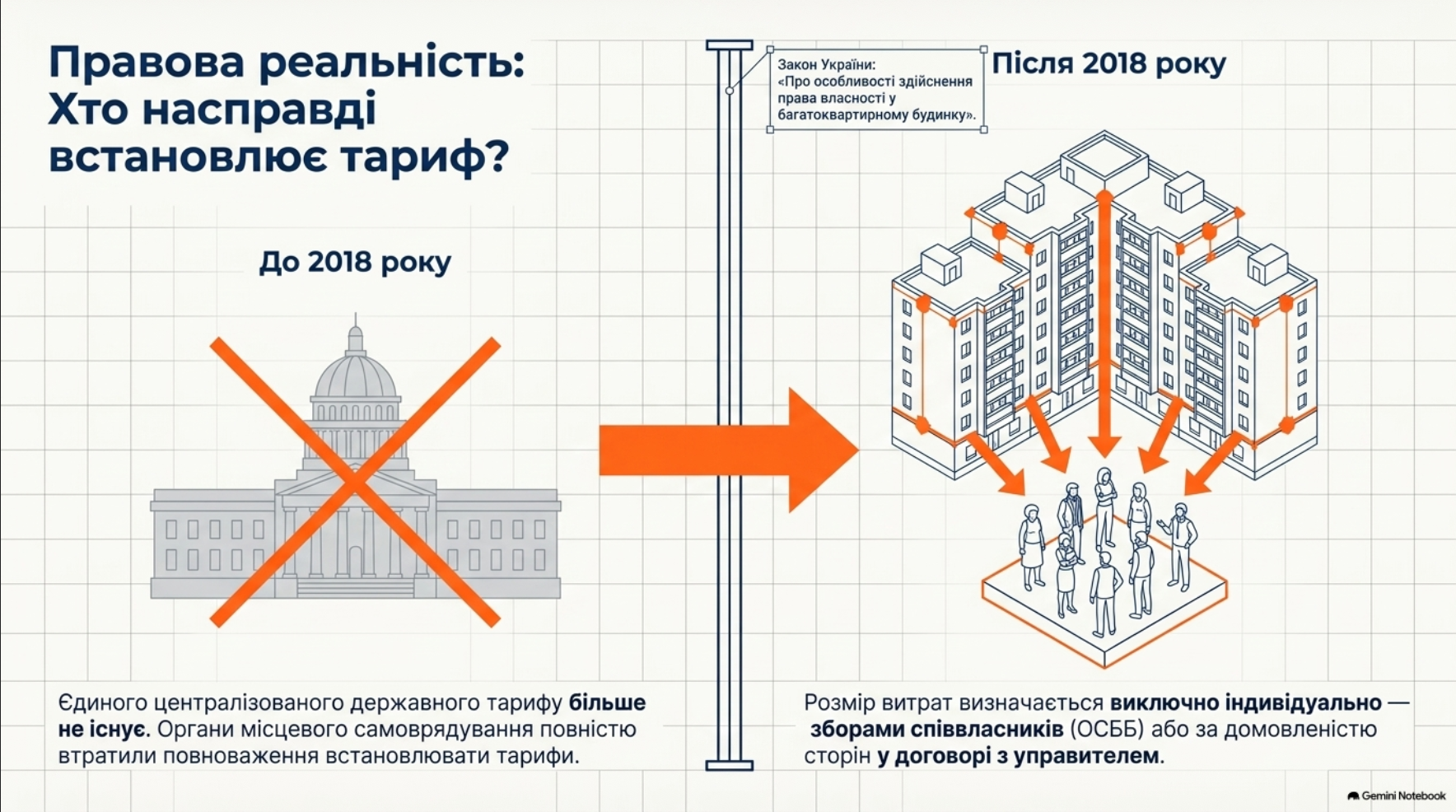
The official explained that, until 2018, maintenance fees for apartment blocks were approved by local authorities. Following a change in the law, the decision on the fee amount effectively passed to the building’s co-owners.
«Until 2018, fees for the management — or, as it was then termed, the maintenance — of multi-storey blocks were approved by local authorities. Since 2018 and as of today, the management fee can be approved either by a resolution of the general meeting of the co-owners of the block of flats, or on a contractual basis with the property manager, or following the results of an open tender to select a property manager for the block of flats,» said Volodymyr Nikolaichuk.
According to him, it is in fact the co-owners who should decide how much they are prepared to invest in their own building and what work is required for its proper maintenance. At the same time, there are no centralised municipal statistics on building management fees.
«Unfortunately, we do not have any centralised municipal statistics or data on how these funds are allocated. We do not have a single, unified tool. We have gathered this data bit by bit — from State Statistics Service reports or from minutes and contracts submitted directly to us,» explained Volodymyr Nikolaichuk.
 What you need to know about maintenance charges for high-rise blocks. Photo: Infographic by the Department of Municipal Services of the Mykolaiv City Council
Why do service charges vary from building to building?
Volodymyr Nikolaichuk noted that there is no single, universal portion of the fee that could be allocated, for example, exclusively to the upkeep of the courtyard. According to him, this is influenced by the area of the site that needs to be maintained, the condition of the building and additional services.
«There are small blocks with large grounds, and there are equally large blocks with small grounds; there may be adjoining areas, or there may be areas which the owners, on the contrary, wish to maintain further,» explained the official.
He added that the proportion of costs allocated to grounds maintenance in various cost estimates ranges from approximately 19–29 per cent. Seasonal work also affects the tariff.
«The winter factor involves snow clearance and the application of de-icing agents or mixtures to de-ice areas. Similarly, the summer factor makes a difference. This involves clearing fallen leaves and mowing the grass around the building,» said Volodymyr Nikolaichuk.
Furthermore, in some cost estimates, the tariff covers not only the maintenance of the grounds but also, for example, the cleaning of stairwells.
«A tariff of three or four hryvnias is an illusion of savings»
Volodymyr Nikolaichuk identifies the maintenance of low service charges in some blocks of flats over many years as one of the main problems. According to him, some management companies are still trying to keep the service charge at 3–4 hryvnias per square metre so as not to lose clients.
«There is a tendency, particularly among management companies, to keep the tariff at this attractive «social» level — say, three or four hryvnias per square metre — where nothing is actually being done, but the management company does not want to lose its position in this market,» he said.
Volodymyr Nikolaichuk believes that this approach creates problems not only for the management company but also for the residents themselves.
«Unfortunately, we have cases of private management companies that are still playing the ‘3–4 hryvnias per square metre’ game in nine-storey blocks with lifts and communal lighting,» he noted.
According to the official, as a result, residents begin to approach the city authorities with complaints about the condition of the building, even though a significant part of the responsibility for its upkeep lies precisely with the co-owners.
«And it all ends with the co-owners, not knowing how these mechanisms work or how these processes unfold, naturally turning to the city authorities. And they also direct their dissatisfaction regarding the upkeep of their building to the city authorities,» said Volodymyr Nikolaichuk.
He describes the low tariff as a «crisis» and speaks of the need for its gradual revision.
«The components of the tariff have long since increased, which is why, unfortunately, it is a crisis that the tariff remains at such a low level,» stated the official.
 What you need to know about maintenance tariffs for high-rise blocks. Photo: Infographic by the Department of Municipal Services of the Mykolaiv City Council
What happens if the tariff is not revised
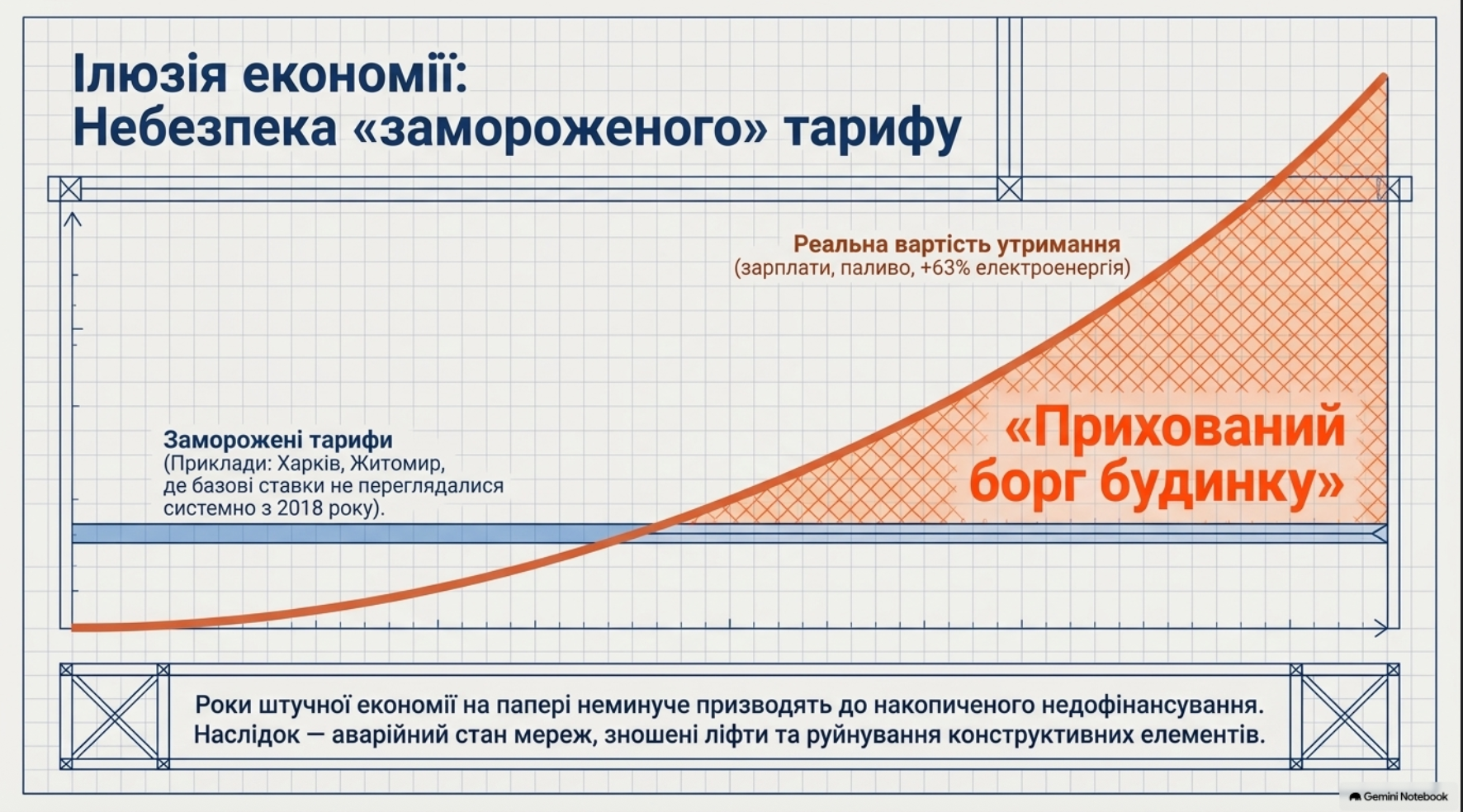
According to Volodymyr Nikolaichuk, artificially keeping the cost of the service low creates what is known as the building’s «hidden debt». He explained that with a tariff that is insufficient for full-scale maintenance, the property manager can only carry out the most basic tasks: dealing with emergencies, preparing the building for the heating season, and cleaning the grounds. Meanwhile, larger-scale problems accumulate.
«This is an illusion of so-called savings, but in reality it is a frozen tariff,» noted Volodymyr Nikolaichuk.
He cited the example of buildings where the tariff has not changed since 2018.
«That is, for the last eight years. I’m not even taking into account the current period of economic difficulties, but rather the pre-pandemic period (up to spring 2020, — note), when this made sense. During this time, everything has changed: the minimum wage, taxes and individual components of this tariff. But there are those, unfortunately, who do not adjust their rates,» he said.
According to him, in such cases, the building appears to continue functioning, but the problems are merely being put off.
«Yes, the building is somehow being maintained in accordance with the regulations. There’s some minimal repair of emergencies, preparation for the heating season, and some cleaning. But a number of problems are building up that cannot be resolved within the framework of the existing tariff, because there are no reserves whatsoever,» explained the official.
Volodymyr Nikolaichuk calls this a ‘time bomb’ that will eventually explode, necessitating significantly higher expenditure.
At the same time, he says, around 97 per cent of Mykolaiv’s housing stock has been privatised, so owners must recognise their responsibility for the condition of communal property.
Why electricity and other costs affect the tariff
Separately, at the briefing, Volodymyr Nikolaichuk spoke about the rising cost of the service’s components. He said that the tariff for the management service itself in Ukraine has risen much more slowly than the individual costs that make up its structure.
«Based on an analysis of data from the State Statistics Service, we can see that the increase in the tariff for the housing service itself is very slow compared, for example, with utility services,» he said.
The cost of electricity, he said, has risen the most.
«Electricity prices have risen by 63.6 per cent in the last year alone. Meanwhile, the management service fee has risen by an average of just 11.2 per cent across Ukraine. These are official figures from the State Statistics Service,» noted Volodymyr Nikolaichuk.
That is precisely why, he said, the tariff — which has not been revised for years — no longer reflects the actual costs of maintaining the building.
The city council sees two options for raising tariffs
Volodymyr Nikolaichuk outlined two possible approaches. The first is a sharp increase in the tariff. He cited Kyiv as an example, where, following tenders for property managers in 2025, tariffs for some buildings rose significantly. According to the official, in some cases the increase was more than double.
The second option is a gradual revision of the tariff, or indexation.
«There is another way — the path of gradual adjustment. This is known as indexation. Property managers and homeowners’ associations must review the rates in line with current changes to the rate components,» he explained.
As an example, Volodymyr Nikolaichuk cited the rise in the cost of electricity.
«Electricity prices rose last year. You need to bring your co-owners together to resolve this issue: Look, unfortunately, our electricity costs have gone up. We can no longer stick to the plans we had drawn up for this year and next year,» he said.
At the same time, some contracts with property managers may already contain provisions for the automatic adjustment of certain tariff components.
Furthermore, Volodymyr Nikolaichuk emphasised that 12 hryvnias per square metre is not the amount the city authorities plan to set for all buildings. It is a benchmark below which, in his view, providing full regulatory maintenance for a typical building becomes economically unviable. That said, new-builds, according to the official, may require an even higher tariff.
«We are not talking about new-builds that have car parks, alarm systems, larger grounds, their own playgrounds and associated features, or appliances or equipment that require additional costs,» noted Volodymyr Nikolaichuk.
He also cited examples of buildings with their own boreholes and water treatment systems, the maintenance of which incurs additional costs.
«And that amounts to more than 12 hryvnias,» said the official.
At the same time, the tariff may differ for smaller buildings. Volodymyr Nikolaichuk cited the example of a small homeowners’ association on 11th Pozdovzhnia Street, where there are two-storey buildings with eight flats each.
«People maintain their buildings themselves, so to speak, or in a community-based way. They don’t collect money for cleaning; they want to set their own cleaning rota. It’s a small community. It’s like a small commune,» he explained.
According to him, the maintenance costs for such a building can be significantly lower, as the residents themselves take on part of the work.
«This is a successful example; having observed them for several years, I really liked this case study. For a small commune, it was a brilliant solution,» noted Volodymyr Nikolaichuk.
What residents should do if services aren’t provided
In addition, the Department of Municipal Services added that residents can request a recalculation if the property manager fails to carry out the work included in the tariff, or change the management company
According to him, residents must first submit a complaint to the property manager regarding the inadequate or non-provision of services. If the property manager does not respond appropriately, the resident may request a recalculation.
At the same time, Volodymyr Nikolaichuk drew attention to a common misconception: one cannot simply stop paying for the service.
«Most people who come to us with this problem do not follow the correct procedure. They simply assume that the service is not being provided properly. For example, cleaning isn’t being carried out, even though it’s an approved part of the tariff for this building. They contact the management company simply with a verbal complaint, by telephone, or just say: «Why aren’t you cleaning? I won’t pay.» Unfortunately, this will not constitute grounds for a recalculation. It will be deemed non-payment, for which the management company may, on the contrary, seek recovery through court or pre-court proceedings,» the official explained.
If the problem is systemic in nature, residents can contact the State Food and Consumer Service or the relevant section of the city council. At the same time, the official believes that in some cases, the best solution may be to change the property manager.
During the briefing, the official also explained that major repairs to the roof, façade, entrance halls or lifts cannot automatically be charged to the city budget. According to him, these are jointly owned assets of the co-owners of a block of flats.
«This is the joint private property of the co-owners of multi-family buildings. The city’s share in relation to the remaining unprivatised flats varies greatly,» noted Volodymyr Nikolaichuk.
At the same time, the city can contribute to such works through relevant co-funding programmes.
«We have programmes in the budget which we adopt at city council sessions, and we draw up the procedures for them. These involve transparent participation and co-funding,» he said.
Furthermore, according to the official, Mykolaiv can take part in state programmes, in particular those run by the Energy Efficiency Fund of Ukraine.
It should be recalled that in 2018, the system for providing housing and communal services in Mykolaiv underwent reform. The old housing and communal services organisations were replaced by the private management company «City for People». The company’s arrival was accompanied by a high-profile utility scandal and disputes, and as early as December 2018, the Mykolaiv Regional Administrative Court annulled the results of the tender to select a management company, which had been won by «City for People Mykolaiv». In November 2018, an article on municipal housing and communal services organisations noted that the tender for residents of the Inhulskyi and Korabelnyi districts, as well as the Soliani neighbourhood, had already taken place and that the court had confirmed its legality, ruling that the claims against the company were unfounded. Prior to that, in October 2018, the Mykolaiv District Administrative Court dismissed an appeal by the «Pivden» Housing and Communal Services Company against an order by the Mykolaiv Department of Housing and Communal Services to announce a tender for the appointment of a manager for multi-apartment buildings.
As of August 2026, there are 289 blocks of flats in Mykolaiv for which a management structure has not yet been determined. The city is preparing to hold a competition to appoint managers for these blocks, but due to the specific characteristics of this housing stock, the process requires further consideration.

Чому ви читаєте «МикВісті»? Яка наша діяльність найбільш важлива для вас? Та чи хотіли б ви стати частиною спільноти читачів? Пройдіть опитування, це анонімно і займе 5 хвилин вашого часу