
A triple astronomical coincidence: the observatory has revealed whether residents of Mykolaiv will be able to observe the solar eclipse, the Perseids and the planetary alignment
- Julia LukyanenkoReporter

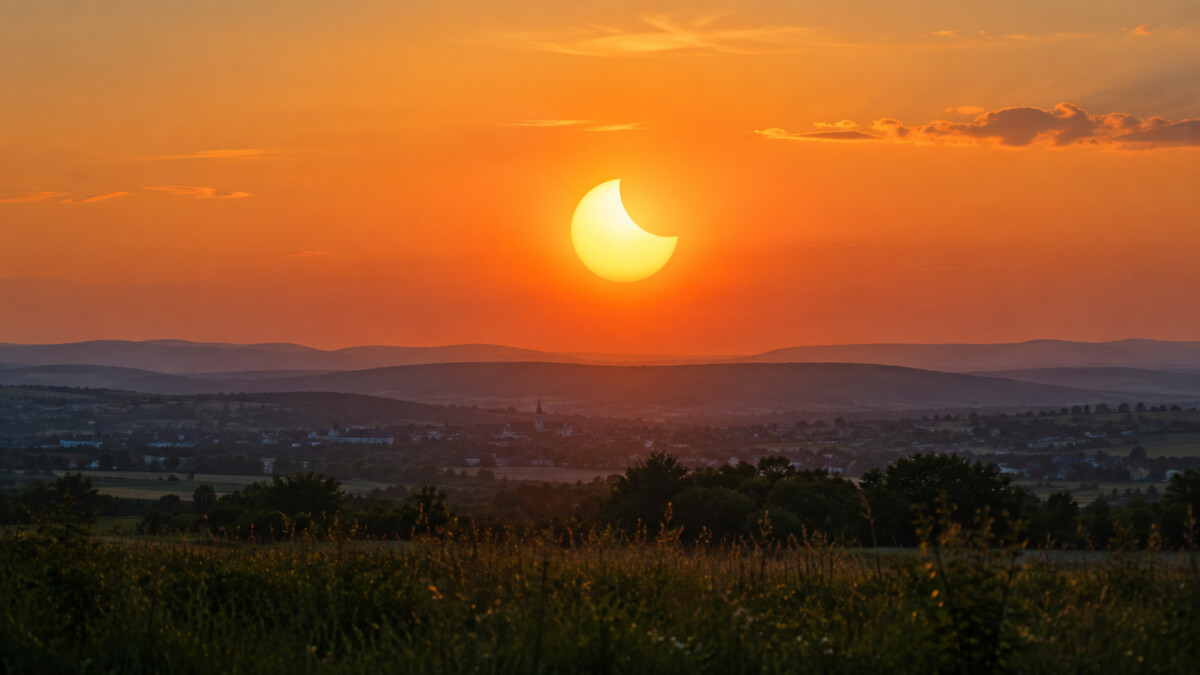 The observatory has explained whether residents of Mykolaiv will be able to see the solar eclipse. Illustrative photo: fbc.net.ua
On Wednesday, 12 August, three natural phenomena will be visible at the same time: a solar eclipse, the Perseid meteor shower, and a planetary alignment.
NikVesti asked staff at the observatory whether residents of Mykolaiv would be able to observe these phenomena and exactly when.
Solar eclipse
The solar eclipse, when the Moon’s shadow covers the Sun, will only be partially visible in Ukraine: specifically, over the western part of the country. It will be visible between approximately 20:10 and 20:19 Kyiv time. The maximum phase in the west of the country — in Lviv and Uzhhorod — is expected at around 20:43–20:47. In the central and northern regions, for example in Kyiv or Vinnytsia, it may be possible to see less than 3–7 per cent of the eclipse between around 20:18 and 20:24, after which the Sun will sink below the horizon.
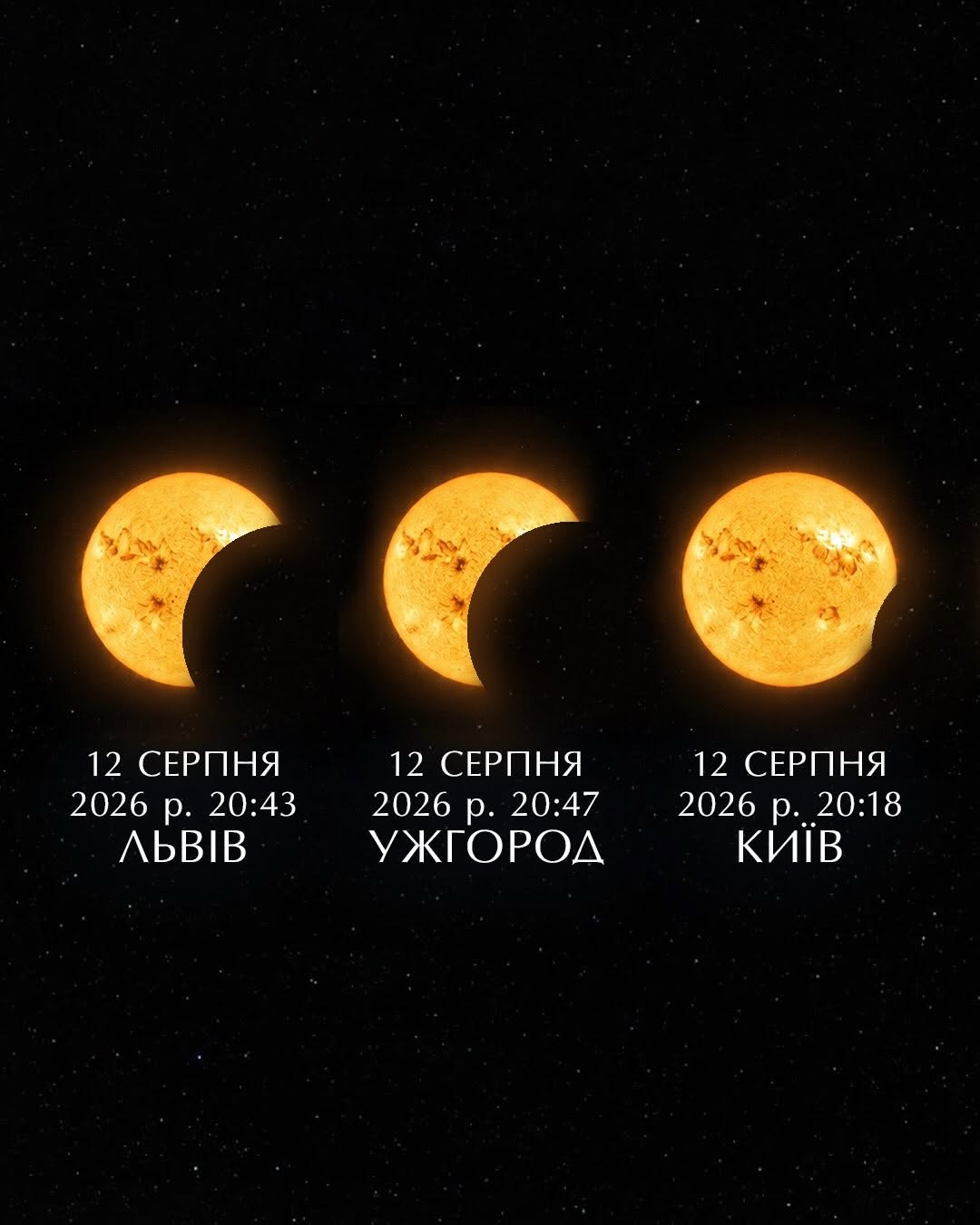 Solar eclipse in Ukrainian cities. Photo: Kyiv Planetarium
According to the observatory, the eclipse will be virtually invisible in eastern and southern Ukraine, as the Sun will set below the horizon either before or at the very start of the eclipse. This means there is little chance of seeing it in Mykolaiv. However, the observatory has warned that anyone wishing to observe the eclipse must ensure they protect their eyes.
«People in Mykolaiv will be able to observe it for a maximum of one minute, but this will be right at sunset. It may be visible on flat, elevated ground,» the observatory said.
In addition, an online event entitled «August Sky: The Perseids and the Solar Eclipse» will be held in Kyiv, featuring a lecture prior to the.
The Perseid meteor shower
Olha Serhiienko, head of the «Nikfior Kalinenkov Astronomical Observatory» laboratory at the Admiral Makarov National University of Shipbuilding, Olha Serhiienko, a research engineer at the Mykolaiv Astronomical Observatory, told NikVesti that the Perseid meteor shower actually has nothing to do with a meteor shower, as it is commonly called.
«A meteor shower has nothing to do with the stars. These are particles from the comet’s nucleus. The origin of this particular meteor shower is the Swift-Tuttle comet. It approaches Earth every 136 years. As the comet orbits, its nucleus breaks up. And when the Earth passes through this region, these tiny particles plunge into the atmosphere, burn up, and we see such beautiful phenomena as what appears to be a shooting star,» noted Olha Serhiienko.
She pointed out that whilst there are many meteor showers, the Perseids are the best known because the shower is bright and summer provides favourable conditions for observation.
The peak of the shower will be on 12–13 August. You can start watching it in the evening, but it will be more clearly visible in the second half of the night.
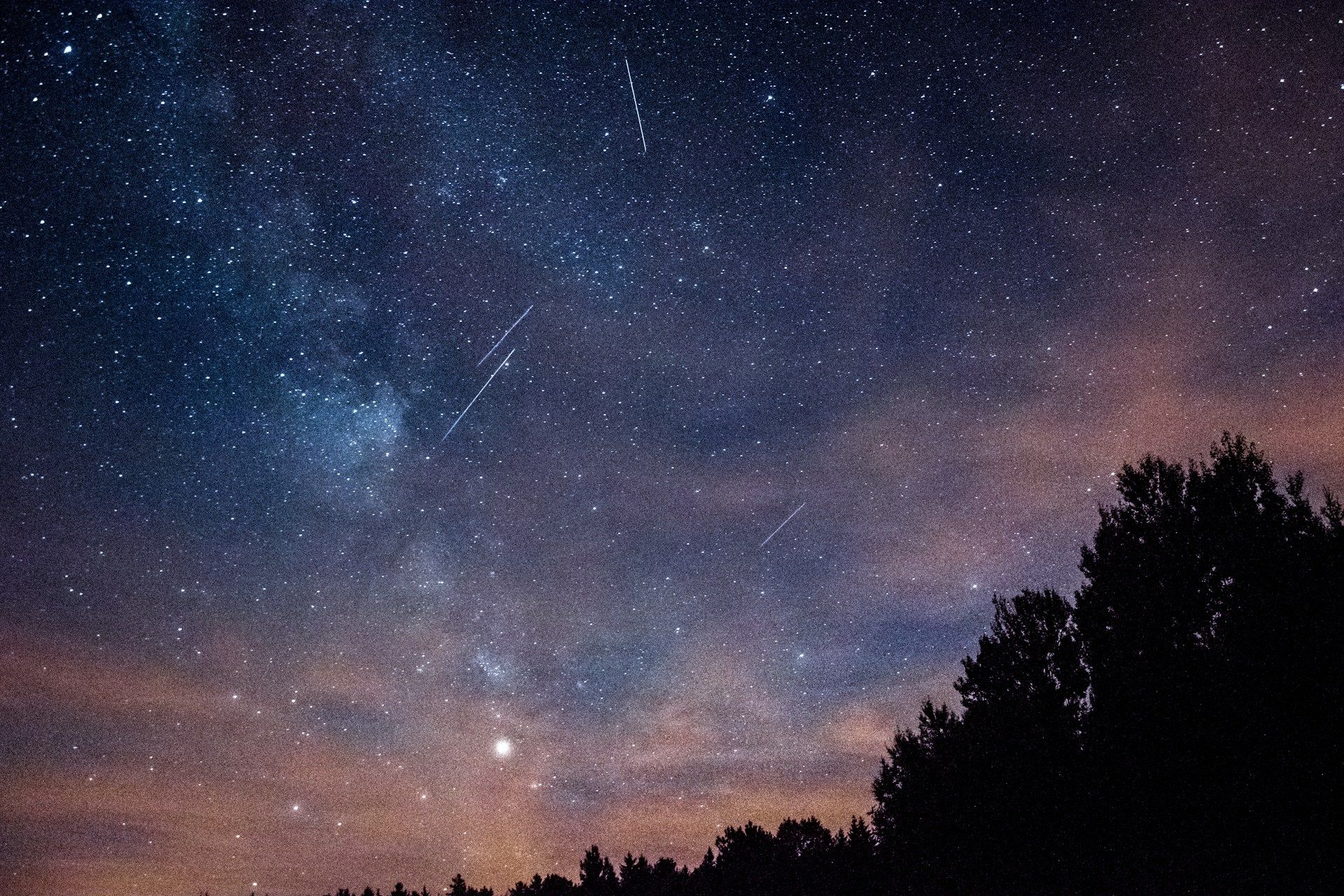 The Perseid meteor shower. Illustrative photo: Channel 24
The Perseids can be seen with the naked eye even in the city, as the streetlights are switched off. The flashes are very fast, so they may not be visible through a telescope. According to the observatory, if you point your phone or camera at the sky, you can capture flashes every 2–3 seconds.
Planetary parade
Olha Serhiienko explained that Venus can currently be seen at sunset. It is the first to appear in the sky and shines brightly.
«If you use any kind of optical equipment, you can observe a phenomenon known as a phase. For inner planets such as Mercury and Venus, you can observe specific phases, just as you do with the Moon. That is, the crescent of Venus, or a quarter of Venus, or three-quarters,» explained Olha Serhiienko.
Residents of Mykolaiv will be able to observe a ‘parade’ of six planets from 11 to 13 August. Olga Sergienko clarified that a true planetary alignment, when the planets line up in a row, is a rare phenomenon that lasts less than a second.
In the early hours of the morning, it will be possible to see Mercury, Mars, Jupiter, Saturn, Uranus and Neptune. You will need to look towards the eastern part of the sky and then turn towards the south-west.
As Olha Serhiienko noted, from around 3 am, it will be possible to observe Mars, Saturn, Uranus and Neptune.
Mars and Saturn are visible to the naked eye. With binoculars, you’ll be able to see Saturn’s rings, as the scientist explained.
Binoculars will also suffice to see Uranus, but Neptune will be visible through a small telescope.
Jupiter and Mercury will appear low on the horizon in the early hours of the morning, 30–40 minutes before sunrise: Mercury will be higher up, Jupiter lower down.
The scientist issued a safety warning regarding the observations:
«This is in the direction of the Sun. Under no circumstances should you look directly at the Sun through any optical equipment. A filter is essential, and preferably fitted at the entrance, so that the eyepiece does not overheat. If you’re looking at Mercury through binoculars, be very careful to avoid a direct line of sight. In other words, when observing Mercury and Jupiter, keep a close watch for exactly when the Sun appears on the horizon. The first five to seven minutes are best. After that, proceed with great caution. This is especially important for children,» added Olha Serhiienko.
It was previously reported that the peak of the Perseid meteor shower in 2026 will occur on the night of 12–13 August, when, under favourable conditions, it will be possible to see up to 100 meteors per hour.

Чому ви читаєте «МикВісті»? Яка наша діяльність найбільш важлива для вас? Та чи хотіли б ви стати частиною спільноти читачів? Пройдіть опитування, це анонімно і займе 5 хвилин вашого часу