RMA: Mykolaiv will be the first city to install cameras on minibuses operated by the TRC to protect people
- Yuliia Boichenko
-
•
-
16:13, 02 September, 2026
In Mykolaiv, there are plans to install cameras on the transport used to take conscripts and reservists to the Territorial Recruitment Centers, military units and training exercises.
This is stated in a letter from the Mykolaiv Regional Military Administration, signed by the acting head, Heorhii Reshetilov, and published by MP Oleksii Honcharenko.
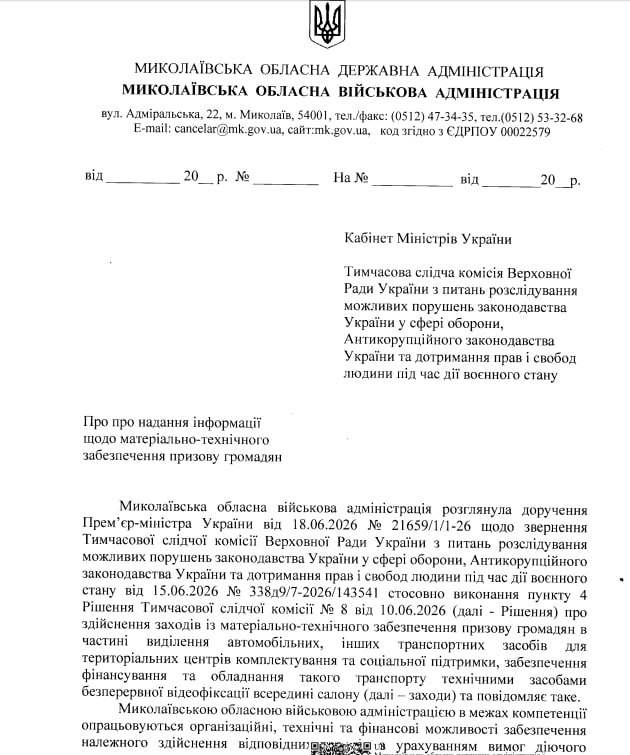 Letter from the Mykolaiv Regional Military Administration signed by the acting head, Heorhii Reshetilov
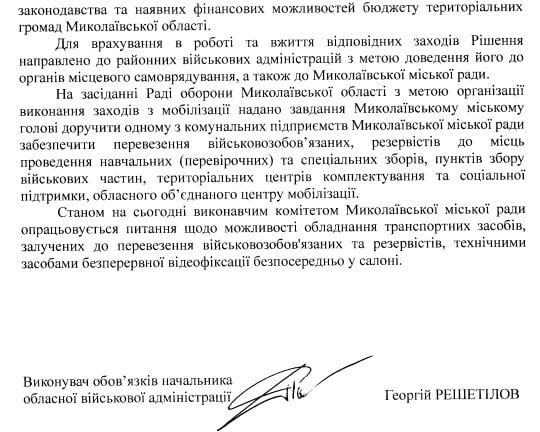 Letter from the Mykolaiv Regional Military Administration signed by Acting Head Heorhii Reshetilov
The installation of the cameras was proposed by the Verkhovna Rada’s Temporary Investigative Commission, which is investigating possible violations in the defence sector and regarding respect for human rights during martial law.
At a meeting of the Defence Council, the mayor of Mykolaiv, Oleksandr Sienkevych, was instructed to organise transport for conscripts and reservists. One of the city’s municipal enterprises is to be enlisted for this purpose.
The plan is to use this transport to take people to the Territorial Recruitment Centre (TRC), military unit assembly points and the regional mobilisation centre, as well as to training and special assembly points.
The city council’s executive committee is currently «exploring the possibility» of installing cameras in these vehicles, according to the Regional State Administration. These cameras are to continuously record everything that takes place inside the vehicle during journeys.
«Cameras in TRC vehicles will ensure compliance with the law and help law enforcement agencies to better investigate any potential unlawful actions by TRC staff.
Mykolaiv was the first to respond; the Regional Military Administration obliged the city council to install cameras in the vehicles. Other cities and regions will follow,» wrote Oleksii Honcharenko.
As a reminder, in August 2026, ten staff members of one of the district TRCs and a joint venture in Odesa were notified that they were under suspicion of torture and the unlawful deprivation of liberty of citizens; preventive measures have already been imposed on those detained.
Earlier, in July 2026, Ombudsman Dmytro Lubinets called for a radical reform of the mobilisation process, stating that up to 90 per cent of mobilisation cases are accompanied by human rights violations, and urging an end to coercive actions by staff at the Territorial Recruitment Centres and Specialised Units.